The Critical Importance of Validation
Imagine investing a year of your life, your savings, and your team’s energy into building a software product, only to launch and hear crickets. Picture the silent dashboard on launch day, the graphs flatlining, the support inbox gathering digital dust. This heartbreaking scenario is not a rare tragedy; it is the default fate of most startups that charge ahead fueled by passion and intuition alone, skipping the deliberate, often uncomfortable, process of validation. It is the story of a team emerging from a long, focused build phase, proud of their elegant code and polished features, only to realize they have been performing a meticulous play to an empty theater.
Validation is the rigorous process of gathering evidence, not AI-generated sentiment or hollow compliments, but hard, behavioral proof that real people have a real problem and are willing to pay for your solution, established before you scale in a landscape where code is cheap but trust is expensive. It is the practice of replacing “I think” with “I know,” transforming your venture from a high-stakes gamble into a series of informed, low-cost experiments. In the 2026 market going into 2027, where launching a product takes minutes but capturing attention takes months, this phase is not a bureaucratic hurdle; it is the fundamental strategic layer that determines whether you are building a defensible business or just another disposable feature.
Crucially, the goal of validation is not to prove your idea is good. That mindset leads to confirmation bias, where you seek out praise and ignore warning signs. Instead, the validation mindset is one of aggressive, even pessimistic, inquiry. Your mission becomes to desperately try to prove your idea is bad before you waste your most precious resources: time, capital, and human spirit. You interview potential customers not to hear “That sounds cool,” but to hear “I don’t really deal with that,” or “I already solved it with a spreadsheet,” or “I’d never pay for that.” You seek out the flaws in your core assumptions about the problem, the audience, and their willingness to engage. You are a scientist trying to falsify your own hypothesis.
This investigative rigor yields one of two invaluable outcomes. The first is the discovery of a rock-solid foundation. You find a group of people whose pain is so acute, whose current solutions are so inadequate, and whose intent to find something better is so clear that you can move forward with immense confidence. You have not just an idea, but a mapped territory of demand. The second outcome is equally precious: a clear, cheap, and early reason to pivot or stop. You might learn the problem isn’t painful enough, the audience is too fragmented, or the economics don’t work. This is not failure; this is a strategic victory. Discovering this after spending $5,000 on interviews and landing page tests is a triumph compared to discovering it after spending $500,000 and two years on development.
Ultimately, this step of pre-build validation is the single greatest determinant between two paths: the path of building something nobody wants a monument to effort devoid of value and the path of building a business. It is the difference between creating a solution in search of a problem and discovering a problem so compelling it pulls the solution out of you. It moves you from being a creator working in a vacuum to a problem-solver operating in the messy, real world of market needs. Skipping it means betting everything on your own infallible insight. Embracing it means building on a foundation of evidence, with your eyes wide open to both the opportunity and the reality you are entering.
The High Cost of Building Without Evidence
Building a SaaS product without validation carries a monumental hidden cost, a multi-layered financial and emotional debt that accrues silently during development and comes due in full upon a silent launch. The most visible layer is the direct cost: the months, often a year or more, of senior developer salaries, designer contracts, and cloud infrastructure fees. It is the recurring subscriptions for project management tools, the premium APIs integrated in anticipation of scale, and the legal fees for terms of service no user will ever read. This is capital actively burning, a runway shortening with each sprint, spent constructing a vessel never pressure-tested for the market’s waters.
More damaging, however, is the opportunity cost, the ghost of roads not taken. While your team is heads-down building a feature set based on hunches, you are blind to other, potentially seismic market opportunities. You are not just spending money; you are spending your one irreplaceable resource—time—on a single bet. You miss the chance to pursue a different idea that emerged from customer conversations you never had. You forfeit the ability to pivot into a related niche that was pleading for a solution. You become tethered to a sinking ship, pouring effort into bailing water while the rest of the fleet sails past toward proven horizons. This cost is invisible on a balance sheet but defines the trajectory of a founder’s career.
But the most insidious and destructive cost is psychological. This is where logic fails and emotion takes command. Founders, by necessity, must believe in their vision to persevere. This belief, over months of coding and designing, transforms into deep emotional investment. The product becomes an extension of the self, a digital child. This creates a powerful cognitive trap known as the sunk cost fallacy. The more time and money invested, the harder it becomes to change course, because pivoting or stopping feels not like a smart business decision, but like a profound personal failure. It feels like admitting the last year of your life was a mistake.
This attachment triggers a vicious, self-perpetuating cycle. Faced with initial indifference, the instinct is not to question the core premise, but to assume the product is merely incomplete. The reasoning becomes, “If we just add this one killer feature, then they will come.” So you dig the hole deeper, building more and more for an audience that does not exist, layering complexity onto a foundation that lacks validation. Each new feature adds more technical debt and makes the product more rigid, further locking you into your initial, potentially flawed, vision.
The final, crushing weight is that of a launched product with no users. An unbuilt idea is light, malleable, full of potential. A built and launched product with no traction is a concrete monument to misapplied effort. It carries the public embarrassment of a silent launch, the demoralization of a team that worked tirelessly for nothing, and the daunting technical debt of a live codebase that must now be either maintained or painfully sunset. This burden can cripple future ventures, seeding doubt and fear where there once was optimism.
Validation is the process that allows you to avoid purchasing this catastrophic lottery ticket with your time, your money, and your spirit. It is the financial and emotional due diligence that ensures you are not just building, but building something the world actually needs and wants. It trades the potential for a spectacular, private failure for the certainty of small, public learnings, any one of which can guide you to solid ground before you have poured your soul into the abyss.
They built a palace of content on a phantom throne,
(Source: The New York Times, “The Quibi Failure”)
and wondered why no one came home.
Quibi, which raised nearly $2 billion but shut down within six months, famously built a sophisticated product for short-form mobile video without validating if a market existed for a dedicated, paid service in a landscape dominated by free, entrenched platforms.

Mindset Shift: From Creator to Investigator
To validate effectively, you must consciously abandon the builder’s mindset, that deep seated instinct to start crafting and architecting, and forcibly adopt the posture of a detective. This is a fundamental identity shift. The builder’s value is in creation, in output, in the tangible lines of code and interfaces they produce. The detective’s value is in discovery, in insight, in the invisible connections and truths they expose. Your primary tool is no longer the code editor or the design system, but raw, relentless curiosity. Your goal is not to create something new, but to uncover something true that already exists in the world: a pattern of frustration, a consistent gap in the market, a silent struggle waiting for a name.
This means your internal dialogue must change. You must silence the voice that declares, “I will build this,” and empower the voices that ask, “What evidence exists that this problem is truly painful?” and “Who feels this pain most acutely, and where do they gather?” and “What are they already doing to cope, and why does it fall short?” This shift is not merely procedural; it is emotional. It requires you to fall in love with the problem itself, to be fascinated by its contours, its history, and its impact. Your initial solution is just a hypothesis, a first draft sketch. You must hold it loosely, be prepared to crumple it up, and start anew based on evidence. The problem is the timeless mystery; your solution is merely today’s theory.
Embracing this role requires profound intellectual humility. You must begin by accepting that your brilliant first idea is likely wrong, or at least incomplete, in some crucial way. The market, your users, the reality of their workflows will contradict your assumptions. The detective does not seek confirmation that their initial hunch was right. They actively seek disconfirming evidence, the clue that breaks the case wide open and points in a new direction. This means you must not just welcome tough feedback, you must hunt for it. You must learn to hear a “no” or sense a hesitation not as rejection, but as the most valuable clue of all. That moment of doubt from a potential user is the signal in the noise, the thread you must pull on to unravel your own biases and arrive at a better, more market fit product. The detective knows the truth is found not in what people applaud, but in what they complain about, avoid, or desperately try to fix with their own makeshift tools. Your job is to listen for the building of those makeshift tools. That is the sound of a real problem waiting for a real solution.
The Source of Great Ideas: Problems Over Solutions
Brilliant SaaS companies are not born from a quest for novel technology. They do not emerge from asking, “What cool thing can I build with this new framework or API?” That path, while intellectually satisfying, often leads to elegant solutions devoid of a critical market need. Instead, enduring companies are born from the often gritty, unglamorous practice of acute problem discovery. The most successful founders are not primarily inventors or technologists in the initial phase; they are problem hunters. Their genius lies not in conjuring ideas from thin air, but in their preternatural sensitivity to friction in the world. They are tuned to a specific frequency: the sound of human frustration.
They listen intently for the raw, unfiltered expressions of this frustration in everyday language. They hear the sighs embedded in phrases like, “I hate how long this takes just to get a simple report,” or the exasperation in, “It’s so frustrating that none of these tools talk to each other.” They pay attention to the financial wince in, “We keep wasting money on overlooked subscription renewals.” These are not mere complaints; they are signals. They are the direct emissions from a problem of significant heat. The problem hunter’s skill is to hear these casual remarks and recognize them as symptoms of a systemic, possibly widespread, issue waiting for a cure.
This understanding leads to a critical formula: your idea’s potential is directly proportional to the intensity of the problem multiplied by its frequency for a specific, identifiable group. Intensity is measured in the emotional and economic cost the searing pain, the genuine fear, the quantifiable loss. Frequency is measured in how often that pain is felt—daily, weekly, at the end of every month. This is why a mild, passing annoyance experienced by millions—a “nice to have”—is often a far worse target than a searing, recurring pain experienced by a few thousand. The former will not motivate action or open wallets. The latter creates a sense of urgency and desperation that a well crafted solution can harness.
Therefore, your primary focus must shift from dreaming up features to obsessively understanding the problem’s context. You must become an ethnographer of the pain point. When exactly does this problem occur? In what workflow, at what time of day or month? What specific event triggers it? How do people currently cope? Do they use a patchwork of spreadsheets, suffer in silence, or pay for an overly complex tool and use only 10% of it? Most importantly, what is the true cost? Map it in triplicate: the time wasted (hours per week), the money lost (direct expenses or missed revenue), and the stress endured (the mental load, the anxiety, the team conflicts).
In this entire process, remember this foundational principle: the solution you initially imagine is a malleable outcome. It is clay to be shaped and reshaped as you learn. It is a hypothesis to be tested. The problem, however, is the fixed target. It is the immutable reality of your potential customer’s experience. Your mission is to study that target with such clarity and precision that when you finally do decide to build, your solution is not a shot in the dark, but a precision strike against the very heart of the difficulty. You are not building because you can; you are building because you must, because you have seen the problem so clearly that not solving it feels like negligence.
Leveraging Public Data to Find Real Pain Points
You do not need to guess about problems or rely solely on your own intuition and limited experience. In the modern digital landscape, you can directly observe them at scale. The internet functions as a vast, open source database of human frustration, need, and desire. It is the world’s largest ongoing focus group, where potential customers are constantly and candidly voicing their pain points, pleading for help, and criticizing the tools they currently use. This happens not in private whispers, but in public forums, on review site comment sections, within community discussion threads, and across social media platforms. This is raw, unsolicited data, free for anyone to analyze.
For a SaaS founder targeting technical users, this is nothing short of a strategic goldmine. Specific platforms become your primary research territories. StackExchange sites, with their question and answer format, are not just help desks; they are live maps of recurring points of confusion and inefficiency. GitHub Issues are where abstraction meets reality, where users file detailed bug reports and feature requests that essentially document the precise gaps and failures of existing tools. Communities on Reddit, such as r/programming, r/sysadmin, or r/dataisbeautiful, provide unfiltered conversation where people share war stories, vent about workflows, and ask peers for better alternatives. Hacker News comment threads often contain deep, critical discussions about the shortcomings of popular technologies. Indie Hackers and similar founder communities reveal the struggles of small businesses and developers trying to piece together their tech stacks.
Within these spaces, people perform a few key actions that signal opportunity. They ask for help, revealing a knowledge gap or a tool limitation. They complain about specific tools, detailing exactly what falls short. They discuss elaborate workarounds, which are perhaps the strongest signal of all—a clear indication that no existing product adequately solves their need, forcing them to invent a clumsy, time consuming solution. Most tellingly, they articulate wishes for better solutions, often phrasing them as “If only there was a tool that could…” or “I wish X did Y.”
The task is to move from passive browsing to systematic analysis. You must read these conversations not as a casual user, but as a social scientist. Your goal is to identify patterns. Is the same struggle mentioned across multiple threads, over months or even years? Do multiple people express frustration with the same specific step in a process? What language do they use to describe their headache? This vocabulary is crucial; it is the very language you will later use in your marketing and product messaging to show instant understanding. By aggregating these observations, you can pinpoint repetitive struggles, map clear gaps in the existing tooling ecosystem, and define a problem space with a richness and specificity that no internal brainstorming session could ever match.
This approach is fundamentally data driven. It grounds your nascent idea in the bedrock of observable reality from day one. Instead of starting with a solution and searching for a problem to attach it to, you start with a clearly documented, publicly verified problem and then ask what the best solution might be. It transforms your venture’s foundation from one of assumption to one of evidence, giving you a formidable head start in the race to build something people genuinely need.
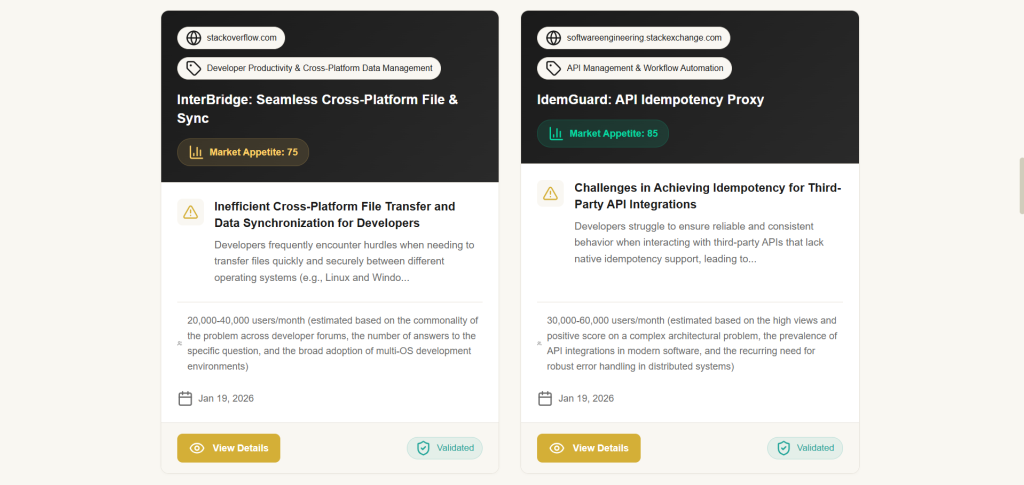
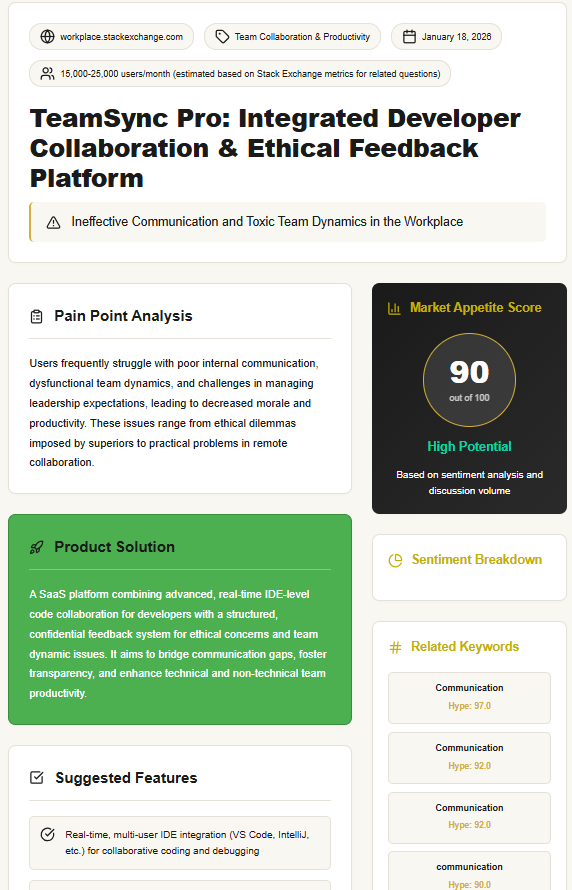
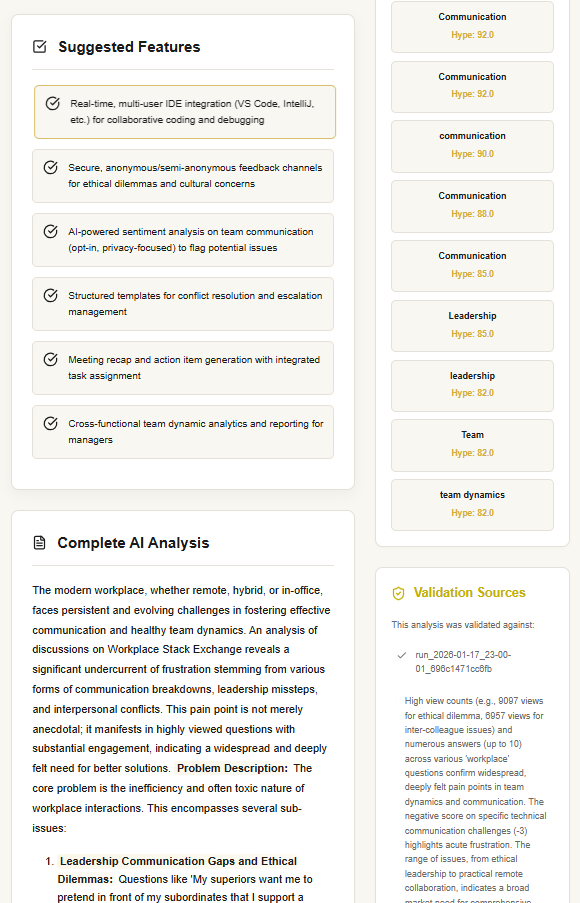
We’ve built a free tool that curates and validates SaaS ideas from stackexchange public data. Leveraging AI, questions people ask on stackechange platform, interests in those questions and answers they receive, to discover pain points, analyze them and generate validated SaaS ideas. Here is an example below;
https://roipad.com/product_trends/trends/idea-detail.php?id=258&slug=ineffective-communication-and-toxic-team-dynamics-in-the-workplace
How to Interpret Trends from Technical Communities
Reading technical forums with the goal of validation requires a disciplined, analytical rigor. This is not casual browsing or reading for personal education. You must approach these spaces as a social researcher mining raw qualitative data, looking not for what is interesting in a general sense, but for specific, actionable signals of persistent pain. The difference is critical. An interesting topic might be a theoretical debate about a new programming paradigm. A pattern of pain is a consistent, grating frustration that interrupts real work on a regular basis.
Your first filter should be quantitative signals of collective interest. A thread with hundreds of comments or a question with a high number of upvotes is a beacon. It tells you that a topic has resonated with a large segment of the community. This is your initial indicator that you are looking at something more than an isolated gripe. However, volume alone is not enough. You must dive into the substance of that engagement.
Pay forensic attention to the “accepted answer” on platforms like Stack Overflow. This is often where the true state of the solution is revealed. Is the accepted answer a clean, direct resolution? Or is it a complex, multi-step workaround involving several tools and clever hacks? A workaround is one of the strongest signals you can find. It represents the community’s best collective effort to bridge a gap left by existing tools. It is a public admission that the proper, native solution does not exist. The more intricate and repeated the workaround, the clearer the market gap.
The comment sections are where nuance and consensus live. Here you must read for specific, telling phrases. When you see comments that state, “I also need this,” or “+1, running into this exact issue,” you are witnessing the validation of a common, shared problem. Comments that say, “This is a known issue with [Tool X],” point directly to a failing in a specific competitor’s product. The most potent question of all is often, “Has anyone found a better way?” This is a direct, vocalized expression of a desire for a new solution, an open invitation for someone to build it.
When analyzing GitHub repositories, shift your focus from the code to the community interaction. The Issues tab is a treasure trove. Look for issues with a high number of thumbs-up reactions or emoji approvals. These are quantified votes for a particular pain point or feature request. Even more telling are issues that are closed with a label like “wontfix” or “third-party,” especially if that closure is met with discontent in the comments. This indicates a need the core maintainers have decided not to address, leaving a segment of users stranded and potentially looking for an alternative.
Finally, you must introduce a temporal dimension to your analysis. Is the topic you are tracking a one-time discussion, or does it resurface every few months? Use search functions to look at threads over the past year or two. A problem that is mentioned consistently over time is a persistent, chronic issue. Furthermore, ask if this pain point is rising in frequency due to a new technology trend. For example, discussions about managing cloud costs might have been sporadic five years ago but are now a dominant, recurring theme. This trend analysis is what allows you to separate a fleeting curiosity, tied to a momentary hype cycle, from a deep, persistent, and scalable problem that is growing in relevance. It is the difference between building on solid ground and building on a wave that is about to crest and recede. This rigorous analytical process is what transforms random observations into the conviction needed to bet your time and resources on a solution.
Defining Your Core Hypothesis: The Problem Statement
Before you speak to a single person, crystallize your core assumption into a clear, testable problem statement. This is your foundational hypothesis. Format it like this: “[Specific Group of People] struggle with [Specific Problem] which causes [Negative Consequence]. They currently solve this by [Current Solution], but this is inadequate because [Key Deficiency].” For example: “Freelance data analysts struggle with manually cleaning diverse client datasets, which causes them to waste 10+ hours per week. They currently use a mix of Python scripts and Excel macros, but this is fragile, time-consuming, and not shareable.” This statement becomes your north star for all validation activities. Every customer interview and test will either support or refute elements of this hypothesis.
Mapping the Problem’s Impact: Time, Money, Emotion
To properly assess the severity of a problem, you must move beyond qualitative descriptions and force it into a quantified framework. This means measuring its impact across three distinct but interconnected dimensions. This triad transforms a vague notion of “something being wrong” into a concrete business case, revealing whether the pain is a mild irritation or a critical wound demanding a surgical solution.
First, quantify the dimension of Time. Time is the universal currency of productivity, and its waste is immediately felt. You must discover not just if time is lost, but precisely how much, and on what specific tasks. Ask: How many aggregate hours per week does this problem consume across a team or an individual’s workflow? Is it 30 minutes of daily frustration, or a full day each month spent on a cumbersome manual process? What are the recurring, predictable tasks involved—data entry, debugging, reconciliation, reporting? The goal is to attach a number to the inefficiency. This number becomes a core part of your value proposition: “Save 10 hours a week.”
Second, trace the impact to Money. Financial consequences make a problem tangible to decision makers. This dimension has several layers. Is there a direct financial loss, such as penalties for errors, fees for failed transactions, or refunds issued due to process failures? Are there higher operational costs, like needing to hire an extra part-time employee to manage the workaround, or paying for multiple tools that together barely solve the issue? Perhaps most significantly, are there lost revenue opportunities because the problem bogs down sales cycles, delays product launches, or prevents scaling? Translating the time wasted into a dollar figure—using fully burdened labor costs is a powerful way to make the economic pain undeniable.
Third, and equally vital, is diagnosing the Emotional and Psychological Toll. This dimension is the engine of motivation. It answers why people will actively seek a solution rather than just passively complain. Is the problem a source of low-grade, constant frustration that drains morale? Does it create anxiety about making mistakes, with professional reputations or job security on the line? Does it cause conflict between teams who blame each other for the broken process? This emotional cost is what turns users into passionate advocates for a solution; they are not just buying efficiency, they are buying relief, peace of mind, and professional confidence.
A problem that scores high in all three dimensions is a powerhouse of potential. It means there is a measurable inefficiency (Time) causing clear financial harm (Money) that people are emotionally desperate to eliminate (Emotion). This combination creates the urgency and budget for a solution.
In your interviews, your questions must be engineered to extract these metrics. Move from the general to the specific. Instead of “Is this a problem?” ask “How often does this specific task or issue occur? Walk me through the last time it happened.” To uncover financial impact, ask “When this process fails or slows down, what is the actual fallout? Does it cost the company money, delay a project, or create extra work?” To tap into the emotional core, ask “How does dealing with this repeatedly make you or your team feel?” Listen for the words that carry weight: “dread,” “anxious,” “stressful,” “exhausting.”

The contrast in responses is stark. A user saying, “It’s a bit annoying,” is a weak signal; it indicates a low severity score across the board. It is background noise. However, a user who states, “It makes me dread Mondays because I know I’ll spend half the day on this manual report, and our finance team estimates the delays cost us about two thousand dollars a month in lost insights,” is giving you an extraordinarily strong signal. They have just provided you with the Time (half a day weekly), the Money ($2k/month), and the Emotion (dread). They have handed you the blueprint for your startup’s reason to exist. This quantified, multi-dimensional pain is the foundation upon which viable businesses are built.
Identifying Your Ideal Early Adopter Profile
Your first customers will never be the entire market. Attempting to appeal to everyone from the outset is a guaranteed path to obscurity, as your messaging becomes a vague whisper lost in a cacophony of noise. Instead, your initial survival and growth depend entirely on a specific, crucial cohort: your Early Adopters. These are not average users. They are the leading-edge individuals who exist in a state of acute discomfort, for whom the problem you are solving is not a minor inconvenience but a daily obstruction to their goals. They are characterized by a powerful triad: they feel the existing pain at its highest intensity, they possess the authority or budget to acquire solutions, and they are already in an active, often frustrated, search for an answer. They are, in essence, already hunting for what you intend to build.
Identifying them requires moving far beyond useless, broad demographic categories. Saying your target is “developers” or “small businesses” is functionally meaningless. You must define them with surgical precision. This means building a composite portrait using three layers of specificity.
First, define their exact role and environment. Not “developers,” but “Senior backend engineers at Series B fintech startups.” Not “marketers,” but “Head of Growth at direct-to-consumer e-commerce brands with in-house development teams.” This includes their industry, company size, and professional title, which informs their challenges, constraints, and spending power.
Second, articulate their specific context and struggle. This is the scenario where the pain lives. For example, they are not just “DevOps engineers,” but ones “who are manually managing and scaling dozens of isolated Kubernetes clusters, leading to chronic configuration drift and security audit failures.” Or not just “content creators,” but “video editors who produce daily content for YouTube and spend hours manually searching for compliant, royalty-free background music.” This contextual lockpin ensures you understand the exact situation triggering the need.
Third, identify their behavioral and psychographic traits. Where do they go to solve problems? What defines their mindset? Are they “active on the r/kubernetes subreddit and the DevOps channel on Tech Discord servers”? Are they “known as early adopters who regularly trial new developer tools from Product Hunt or Hacker News”? Do they “frequently author blog posts or speak at meetups about infrastructure challenges”? These behaviors indicate how they seek solutions and where you can find them.
Crafting this detailed profile is your most important strategic exercise before any outreach. It transforms your business development from a scattered broadcast into a targeted hunt. You are no longer casting a wide net hoping to catch something; you are using a spear to aim for a single, specific fish. You know its habitat, its diet, and its migration patterns. This focus allows you to craft messaging that resonates with profound empathy because you are speaking directly to a known, detailed reality. It tells you which online communities to engage in, which keywords to use in ads, and what language to use on your website.
Ultimately, you are not looking for everyone. You are hunting for the specific individuals whose pain is so burning, so present, that it overcomes the natural risk aversion of trying an unproven solution from an unknown startup. They are willing to tolerate initial imperfections the rough edges of an MVP—because you are offering relief from a pain they can no longer endure. They are not just your first customers; they are your collaborators, your validators, and your most powerful source of truth. Finding them is not a marketing task; it is the foundational act of market creation.
The Art of the Customer Discovery Call
The customer discovery call is a unique and disciplined form of conversation, fundamentally different from a sales meeting, a product demo, or a friendly chat. It is a structured, goal-oriented dialogue whose sole and sacred purpose is learning. You are not there to persuade, promote, or present. You are there as an anthropologist entering a new culture, with the goal of understanding the native’s environment, rituals, and pain points from their perspective. Any shift away from this learning mandate corrupts the process and yields biased, useless data that will lead you astray.
Initiating this conversation requires a carefully crafted outreach that establishes the correct tone from the first sentence. Your message to potential interviewees matching your Early Adopter Profile must radiate humility and genuine curiosity. A framework like, “I’m trying to understand how [people in your specific role, e.g., DevOps leads] handle [the specific problem area, e.g., monitoring microservice costs]. I’m not selling anything. Would you have 20 minutes to share your experience?” is effective. This formulation does several critical things: it flatters their expertise, clarifies the topic, disarms their sales defenses by stating you are not selling, and makes a small, respectful request for their time. The goal is to make them feel like a respected teacher, not a sales target.
Once the call begins, your primary role is that of an empathetic listener. Your agenda, which you may even state at the outset, is simple: to explore their world. You are there to validate the dimensions of the problem you suspect exist and, more importantly, to discover dimensions you never considered. You must understand their current workflow in granular detail. While you should prepare a short list of open-ended questions to guide the conversation—questions focused on process, pain points, existing solutions, and desired outcomes you must hold them lightly. Your priority is to let the conversation flow naturally, to follow the threads they offer, even if they lead away from your initial script. The most valuable insights often come from unplanned tangents and spontaneous examples.
Your mindset during this call is your most important tool. You must practice active listening, which means fully concentrating on what is being said, not just passively hearing while you formulate your next question or, worse, your next pitch about your idea. Use verbal nods like “I see,” or “That’s really helpful context.” Ask clarifying questions that dig deeper: “You mentioned this happens every quarter can you walk me through what that week typically looks like?” or “When you say the current tool is ‘clunky,’ what specifically makes it so?”
Crucially, you must resist the powerful urge to jump in with your solution when they describe a problem that fits your idea. This is the ultimate test of discipline. If you reveal your concept, you irrevocably poison the well. You will shift their mindset from explaining their reality to evaluating your proposal, and you will start receiving polite opinions instead of raw truths. Your success metric for this call is not their praise for your idea, which is worthless at this stage, but the depth and novelty of the insight you gain. A successful call leaves you with a richer, more nuanced, and often more complicated understanding of the problem than you had before. It provides specific quotes, real-world stories, and concrete data points about time, cost, and emotional toll. You are mining for the reality of their situation, and your measure of success is the weight and purity of the ore you bring back, not a pat on the back for the mine you hope to build. This rigorous approach to listening is what separates founders who build based on market truth from those who build based on personal fiction.
Crafting Questions That Uncover Truth, Not Politeness
In the critical process of customer discovery, a fundamental human trait becomes your greatest obstacle: politeness. People are naturally inclined to be helpful and agreeable, especially in a structured conversation. When they sense your passion or hear your nascent idea, their instinct is often to encourage you, to avoid hurting your feelings, or to provide the answer they believe you are seeking. This well-intentioned filter results in a dangerous mirage of validation, where you hear “That sounds like a great idea!” instead of the raw, unfiltered truth about their actual behaviors and pains. Your paramount job as an investigator is to develop techniques that bypass this social filter and excavate the underlying reality.
This requires meticulous care in how you phrase every question. You must eliminate any hint of leading the witness. Avoid questions that embed your own assumption of frustration, such as, “Don’t you think it’s frustrating when the system slows down?” This question merely asks for agreement with your premise. Instead, you must use neutral, exploratory prompts that grant the interviewee full sovereignty over their response.
Begin by establishing broad, non-threatening context. Open with: “Talk me through your typical process for [a related, high-level task], from start to finish.” This invites a narrative, not an opinion. It allows you to observe their workflow and listen for the natural pauses, sighs, or points where they elaborate with negative emphasis.
Once they’ve outlined the process, dig into the pain points with open curiosity. Ask: “Looking at that whole workflow, what part feels the most tedious, repetitive, or error-prone?” This allows them to identify the friction point themselves, rather than you pointing to it. The specific word they choose—”tedious,” “fragile,” “annoying,” “scary”—is invaluable data.
Then, explore their current solutions without judgment. Inquire: “What are you currently using, if anything, to handle that specific part? What’s one thing you love about that method, and one thing you hate?” The “love/hate” framework forces a balanced, concrete assessment. The “hate” reveals the gap; the “love” reveals what any new solution must preserve or improve upon.
To quantify aspirations without biasing them toward your concept, employ the magic wand question: “If you could wave a magic wand and change one thing about how that process works, what would it be?” This question bypasses constraints of budget, feasibility, and politics to reveal their core desired outcome—the “job to be done.” Their answer is the purest signal of what they value most.
However, the most powerful technique in your arsenal is to anchor questions in the concrete past, not the hypothetical future. Human memory for specific events is far more reliable and truthful than our predictions about our own future behavior. Crucially ask: “Tell me about the last time you encountered this issue. What were you trying to do? What exactly happened?” or “Describe the most recent instance where this problem created a real headache for you.”
A story about a specific past event is a window into truth. It provides details about context, triggers, actions taken, emotional response, and consequences. You will get facts instead of opinions. You might learn that “last Thursday, I spent three hours manually merging spreadsheets because the API failed, which made me miss my kid’s soccer game, and my manager was upset about the delayed report.” This one sentence contains quantifiable time (3 hours), a technical cause (API failure), emotional toll (personal sacrifice, stress), and professional consequence (manager displeasure). This is radically more valuable than a generic, polite opinion like “Yeah, data integration can be tricky sometimes.”
Mastering this art of neutral, past-oriented questioning is what separates insightful discovery from a collection of misleading compliments. You are not conducting a survey; you are gathering case studies. Your transcript should be filled with specific stories, exact quotes of frustration, and detailed accounts of current workarounds. This is the raw material from which you can confidently discern a real, urgent problem from a phantom one. It ensures you are building your understanding, and eventually your product, on a foundation of human behavior, not on a foundation of polite fiction.
Below is a screenshot from our opensource tool that generates validated SaaS ideas from stackexchange and public data
Where to Find People Willing to Talk
Finding interviewees for customer discovery is not a passive activity of waiting for volunteers. It is an active, strategic outreach campaign that requires the same focus and effort as a critical sales initiative. You are not casting a wide net; you are spear-fishing for very specific individuals who match your Early Adopter Profile, and this demands a multi-pronged, personalized approach.
Begin by leveraging your existing professional network, but do so with precision. On LinkedIn and Twitter, move beyond generic posts. Craft direct, personal messages to former colleagues, acquaintances, or respected voices whose roles align with your target. The message must foreground learning, not your idea. For example, “Hi [Name], I’ve been researching challenges around [problem area] that [people in their role] often face. Given your experience at [Their Company], I’d be grateful for 20 minutes to learn about your perspective. Happy to share my findings afterward.” This approach respects their expertise and frames the call as a knowledge exchange.
Expand your reach into the digital habitats where your potential users congregate. Identify specific Slack or Discord communities dedicated to your niche—whether it for UX designers, data engineers, or e-commerce founders. Join these communities with a contribution mindset first. After participating genuinely, you can post a concise, humble request in appropriate channels: “I’m conducting research on [specific problem] to better understand the workflow challenges. Would any [role] here be open to a brief 20-minute interview? I’m offering a $10 coffee gift card as a small thank you for your time.” The incentive is not a bribe; it is a token of respect that significantly increases response rates and shows you value their expertise.
Public platforms like Indie Hackers or relevant subreddits are also fertile ground, but the rules are strict: you must not pitch. Create a post that is transparent about your learning goals. A title like “Researching [Problem Area] – Seeking to Interview [Specific Roles]” with a body text explaining you are in the discovery phase and want to understand pain points can attract qualified, helpful individuals. The comment section of such a post can also reveal public discussions about the problem, giving you more leads and context.
For systematic, scalable outreach, tools like LinkedIn Sales Navigator are invaluable. They allow you to filter by exact job titles, industries, company sizes, and even keywords in profiles. This lets you build a list of ideal candidates. Your connection request or InMail message must be impeccably tailored, referencing their specific role or experience to demonstrate this is not a spray-and-pray message.
One of the most powerful methods is to return to the source: the forums and repositories where you first observed the problem. On StackExchange or GitHub, where you’ve identified recurring issues, begin by providing genuine, helpful answers to existing questions. This builds public credibility and goodwill. Once you have established a minimal positive presence, you can privately message a user who authored a detailed question or comment. Your message can reference their specific post: “I saw your detailed question on [topic] about [specific issue]. I’m doing deeper research in this area and found your perspective insightful. Would you be open to a brief follow-up chat about your experience? I’d love to learn more.” This method is exceptionally effective because you are approaching someone who has already publicly demonstrated their pain, and you’ve first provided value.
The entire process is a litmus test. If, after deploying these varied tactics with sincere effort, you cannot secure conversations with 10 to 15 relevant people, you must confront a stark reality. This difficulty is not a logistical failure; it is a profound market signal. It suggests one of two critical flaws: either the problem lacks sufficient urgency for people to spend 20 minutes discussing it, or your target audience is too elusive and poorly defined. In either case, it serves as a major red flag. The market’s reluctance to even talk about a problem strongly predicts its reluctance to pay for a solution. This resistance is not a barrier to overcome through harder hustle; it is crucial feedback telling you to re-evaluate the problem or the profile you are pursuing before a single line of code is written.
Conducting Effective Interviews: A Step-by-Step Script
Having a loose script ensures you cover key ground while staying conversational. Here’s a framework:
- Introduction (2 min): Thank them, restate the goal (to learn about their work), assure them you’re not selling.
- Context Setting (5 min): “Tell me about your role. What are your key responsibilities related to [problem area]?”
- Deep Dive on Current Process (10 min): “Walk me through how you currently handle [specific task]. What tools do you use? Where do things usually break down or get slow?”
- Pain Point Exploration (10 min): “What’s the biggest headache in this workflow? How does that impact your work/team/business? Can you give me a recent example?”
- Solution Ideation (5 min): “How have you tried to solve this? What would an ideal solution look like for you?”
- Wrap-up (3 min): “Is there anyone else you know who struggles with this that I should talk to?” Thank them.
Record (with permission) and transcribe for analysis.
Analyzing Interview Data for Common Themes
After completing 10 to 15 customer discovery interviews, you are sitting on a wealth of raw, qualitative data. This is a critical juncture. The immediate temptation is to trust your gut feeling or latch onto the most memorable stories. This is a dangerous mistake. You must now transition from collector to analyst. You need to step back from the individual conversations and systematically look for patterns that cut across multiple interviews. This analysis cannot rely on memory or impression; human recollection is inherently biased, favoring the dramatic, the most recent, or the comments that best confirmed your existing hopes. You must employ a methodical, almost mechanical, process to distill truth from the transcripts.
Begin by transferring your notes and recordings into a structured format. A simple spreadsheet is often the most effective tool. Create a row for each interviewee. Establish columns for key data points: their role and context, direct quotes that capture their pain, the specific pain points mentioned, the current tools or workarounds they employ, and their stated or implied desired outcomes. If you have transcripts, use a qualitative coding method, highlighting and tagging recurring themes like “time loss,” “error-prone,” “fear of mistake,” or “manager pressure.”
Your objective is to move from individual anecdotes to aggregated evidence. Scan your data vertically, down each column. Look for recurring phrases and specific vocabulary. Are three different people calling their current process a “house of cards” or a “constant fire drill”? That shared language is a powerful signal of a shared reality. Identify emotional cues. How many expressed not just mild annoyance, but genuine frustration, anxiety, or even anger when describing a particular step? Strong, negative emotion is a key indicator of a high-severity pain point.
Quantify your observations. Tally how many interviewees mentioned the same specific sub-problem. For instance, if you’re exploring project management pain, how many specifically cited “the impossibility of forecasting timelines accurately” versus “difficulty assigning tasks”? Note if a common, makeshift workaround emerged independently across multiple people—such as using a combination of Google Sheets, Slack reminders, and weekly manual audits. A prevalent workaround is one of the strongest possible indicators of a market gap.
The ultimate goal of this synthesis is to identify the core “job to be done.” This is not the surface-level task, but the fundamental progress the user is seeking in a given situation. Are they just trying to “send a report”? Or is the deeper job to “feel confident in my data before presenting to leadership” or to “avoid blame for a delayed project”? The job is the underlying need, and your solution will be hired to fulfill it.
The outcome of this analysis will fall into one of two categories, providing clear directional guidance. If your interviews reveal a fragmented set of minor, unrelated issues—where everyone has a different small gripe—the problem you are investigating lacks a sharp, unifying point. It may be a symptom of a larger, ill-defined frustration, or it may simply not be severe or consistent enough to build a focused business upon. This is a sign to refine your problem statement or explore a different angle.
Conversely, if 8 out of 10 people describe the same core nightmare using strikingly similar words, expressing strong emotion around the same bottleneck, you have uncovered a powerful, resonant theme. This pattern is the foundation for your value proposition and product roadmap. It tells you not only that a real problem exists, but precisely how your target audience articulates it and what emotional and functional resolution they seek. This concentrated pattern is the signal that you have likely found a problem worth solving, and it provides the authentic language and priorities you must use to build a solution that truly resonates. This analytical process transforms a series of conversations into a strategic blueprint.

Validating Market Size: Is It a Niche or an Ocean?
To determine if your solution can support a viable business, you must move beyond the qualitative pain and quantify the opportunity. This is the process of validating market size, often framed as a simple question: Is this a niche or an ocean? The answer isn’t found in a single number, but in a layered, realistic analysis that grounds your vision in economic reality. The goal is not to claim a billion-dollar market to impress investors, but to prove a reachable market exists to sustain your company.
This analysis is best done through a bottom-up approach, moving from your specific beachhead to the wider horizon. Think of it as three concentric circles:
1. The Total Addressable Market (TAM): The “Ocean.”
This is the theoretical maximum revenue if you captured 100% of everyone who could possibly use your solution. For a B2B SaaS, calculate it as:
[Number of Potential Companies] x [Average Annual Revenue Per User (ARPU)].
For example, if you’re targeting mid-market e-commerce companies in the US (say, 20,000 companies) with a solution you could price at $5,000/year, your TAM is $100M. This number is useful for context but is largely an abstraction—you will never capture it all.
2. The Serviceable Addressable Market (SAM): The “Addressable Coastline.”
This is the segment of the TAM you can realistically reach and serve with your specific product, sales model, and capabilities. It applies key filters. Using the e-commerce example, perhaps your solution only works for companies using Shopify Plus (filtering to 5,000 companies). Your SAM is now 5,000 x $5,000 = $25M. This is a more honest representation of your potential playing field.
3. The Serviceable Obtainable Market (SOM): Your “Beachhead.”
This is the portion of the SAM you can realistically capture in the first 3-5 years. It considers fierce competition, market penetration rates, and your limited resources as a startup. A reasonable starting SOM might be 5% of your SAM in Year 5. In our example, 5% of the $25M SAM = $1.25M in annual revenue. This is your critical number. Is building a company to achieve and grow from ~$1.25M in ARR a worthwhile venture for you? If yes, the market is viable.
Illustrations of the Process:
Diagram: The Three Circles of Market Sizing
    [TAM: The Ocean]
    (e.g., All Businesses)
          |
          V
    [SAM: The Addressable Coastline]
    (e.g., All US E-commerce)
          |
          V
    [SOM: Your Beachhead]
    (e.g., 5% of Shopify Plus Stores)
Case Example 1: Figma’s Early Days
- TAM: All digital designers and teams involved in design (a huge ocean).
- SAM: Product designers and UI/UX teams in tech companies who collaborate and need a modern, web-based tool (a large coastline).
- SOM: Early adopter UI/UX teams in San Francisco/SF Bay Area tech startups who were frustrated with existing, clunky desktop tools and valued real-time collaboration (a clear, reachable beachhead). They conquered this niche before expanding.
Case Example 2: A Modern DevOps Tool
- TAM: All software development teams globally.
- SAM: DevOps/SRE teams at mid-to-large tech companies (500+ employees) using Kubernetes in production.
- SOM: 2% of those SAM teams in North America who are actively struggling with cost management and are early adopters, likely found in communities like DevOps subreddits or KubeCon.
How to Execute This Analysis:
- Find the Numbers: Use resources like LinkedIn Sales Navigator filters, industry reports (Gartner, Forrester, IDC), government databases (U.S. Census, Bureau of Labor Statistics), and niche community data to estimate the number of potential companies/users.
- Apply Your Filters: Ruthlessly layer on your constraints: geographic focus, tech stack compatibility, company size, specific vertical. Each filter shrinks the TAM to your SAM.
- Set a Realistic Penetration Rate: For your SOM, research typical SaaS penetration rates. 1-5% in years 3-5 is often a reasonable, credible starting point for a new entrant.
- The Budget Check: For B2B, verify that your target companies have the budget. Is your $5,000/year solution a decision for a department head, or does it require C-level approval? What other tools in their budget indicate willingness to pay?
A niche market of 50,000 passionate, under-served users willing to pay $500/year is a $25M TAM—more than enough to build a profitable, impactful company. Conversely, a “billion-dollar TAM” that is diffuse and impossible to reach with your resources is a mirage. This disciplined exercise forces you to move from “everyone could use this” to “here is exactly who will buy this first, and here’s how we find them.” It confirms whether the problem you’ve uncovered is a widespread business need or a narrow edge case. Ultimately, it’s better to be a dominant leader in a defined niche than a forgotten drop in an ocean.
Competitive Analysis: Learning from Existing Solutions
The presence of competition is not a stop sign; it is the first green light you encounter on the road to validation. It proves that real people are experiencing a real problem with enough urgency that they are already spending time and money to solve it. A complete absence of competition is often a far more dangerous signal—it may indicate a lack of market demand, a problem too insignificant to warrant a solution, or a business model that is impossible to sustain. Therefore, your task is not to avoid competition, but to understand it better than anyone else, using it as a live blueprint of the market’s needs and failures.
Begin by systematically mapping out every alternative a potential customer might consider. This landscape is broader than just direct competitors. Categorize them into three tiers:
- Direct Competitors: Other SaaS companies or software products that solve the same core problem in a similar way.
- Indirect Solutions: The tools people rig together to cope. This includes generalized software (like spreadsheets, Notion, or Google Docs), homegrown scripts, manual processes, or using a powerful but misaligned tool (like using a full project management suite to track a single recurring task).
- The Status Quo: Often the most formidable competitor of all: “doing nothing.” This is the choice to endure the pain because the perceived hassle or cost of switching to any solution is higher than the pain itself.
With this map, create a detailed comparison matrix. For each alternative, analyze four key dimensions:
- Strengths: Where do they excel? Is it brand trust, a comprehensive feature set, a low-cost entry point, or deep integrations?
- Weaknesses: Where do they falter? Is the interface outdated, the learning curve steep, the pricing opaque, or the customer support slow?
- Pricing: What is their model (per user, per feature, tiered)? Does it become prohibitive at scale? Is there a confusing setup fee or mandatory annual contract?
- Customer Sentiment: Read between the lines of reviews on sites like G2, Capterra, and Trustpilot. Look beyond the star rating. What specific praises do users repeat? What grievances emerge consistently? Phrases like “great for enterprises but overkill for us” or “requires a dedicated admin to manage” are gold.
This analysis crystallizes around one pivotal question: “Why isn’t everyone already using the best existing solution?” The answers to this question are the master keys to your opportunity. They reveal the persistent gaps and friction points in the current market. Perhaps the leading tool is phenomenally powerful but requires a team of specialists to operate, leaving mid-market companies stranded. Maybe it’s affordable to start but has punitive pricing scales that alienate growing businesses. Perhaps it’s built for a generic audience and misses critical workflows unique to a specific vertical, like healthcare, construction, or legal services.
Your opportunity lies not in creating a slightly better clone, but in strategically serving an underserved segment with a focused solution. This is the essence of positioning. You can win by:
- Serving a Neglected Segment: Building for smaller businesses when the incumbent focuses on enterprises (like Salesforce vs. HubSpot in the early days).
- Prioritizing a Different Value: Offering radical ease-of-use and simplicity when the market leader is a complex “power tool” (like Canva vs. Adobe Photoshop for non-designers).
- Solving for a Specific Vertical: Building features that cater to the unique regulations, workflows, or integrations of a specific industry that generalist tools ignore.
- Innovating on Business Model: Offering transparent, usage-based pricing in a market of opaque enterprise contracts, or a frictionless self-serve trial in a market dominated by slow sales demos.
This competitive analysis does more than just identify a gap; it defines your sword and shield. It tells you exactly where to attack and how to defend. It provides the language for your marketing—you can speak directly to the frustrations users have with the status quo. It informs your product roadmap—you know which features are table stakes and which are your differentiators. By understanding not just that competition exists, but why it has failed to completely satisfy the market, you discover your own right to exist and the focused path to claiming your territory.
Identifying Your Unfair Advantage and Differentiator
This distinction is the cornerstone of strategic positioning for any startup. It separates features from foundation, and effort from edge. To build a lasting business, you must clearly define both your Differentiator and your Unfair Advantage. They are not the same, and confusing them leads to fragile strategies that competitors can dismantle with ease.
1. Your Differentiator: What You Do Differently
This is your unique value proposition visible to the customer. It’s the answer to “Why should I buy from you and not them?” It’s a conscious choice you make about how you will deliver value in a distinct way.
Illustrative Examples of Differentiators:
- Feature Innovation: Calendly didn’t invent scheduling, but it differentiated by making it dead-simple through a single, shareable link—a feature that became its core identity.
- UX/Simplicity: Dropbox competed in a crowded storage market not with more space, but with a radically simpler user experience. The magic of the folder was their differentiator.
- Specific Integration: A project management tool that differentiates by offering a deep, two-way sync with GitHub Issues for developers, while competitors offer only generic webhooks.
- Pricing Model: Notion’s early differentiator was offering an all-in-one workspace at a single price, challenging the model of paying separately for docs, wikis, and tasks.
Think of your differentiator as your “Go-To-Market Weapon.” It’s what you lead with in your messaging.
2. Your Unfair Advantage: Why Only You Can Do It Successfully
This is the deeper, often structural, reason you can win and defend your position. It’s not just what you do; it’s what you uniquely possess or are that cannot be easily bought, copied, or replicated by a competitor. It’s your moat.
Illustrative Examples of Unfair Advantages:
- Foundational Domain Expertise: The founders of Vanta had deep, firsthand experience with the grueling SOC 2 compliance process. Their unfair advantage wasn’t just the software; it was their innate understanding of the customer’s pain, enabling them to build the right solution faster and with more credibility.
- Proprietary Data or Insight: A tool (like the one you described) that mines StackExchange trends has an unfair advantage in problem discovery. It has a systematic, data-driven head start in finding validated opportunities that others relying on gut feeling do not.
- Unique Community Access: A founder who has built and nurtured a 50,000-member online community for indie game developers has an unfair advantage in launching a tool for that market. They have direct distribution, trust, and feedback channels.
- Existing Distribution Channel: A company with a popular open-source project has an unfair advantage in launching a commercial SaaS version. They have a built-in user base and organic growth engine.
Think of your unfair advantage as your “Defensive Fortress.” It’s what protects you once you’ve captured ground.
Visualizing the Relationship:
[Your Unfair Advantage] (The Foundational Rock)
        |
        V
It enables you to build and sustain...
        |
        V
[Your Differentiator] (The Sharp Spearhead)
        |
        V
Which you use to attack the market and win customers.
A Concrete Combined Example: Figma
- Unfair Advantage (Early On): A founding team with exceptional technical expertise in WebGL and a visionary belief in the web-as-platform at a time when the market (Sketch, Adobe) was all native desktop apps. This was a hard-to-copy technological and philosophical foundation.
- Differentiator: “Real-time collaborative design in the browser.” This was the sharp spearhead that attacked the incumbents’ weakness (isolation, file-sending).
A Self-Assessment Framework:
Be brutally honest. Fill in these blanks:
- “Our primary differentiator is
[Specific Feature/Model/UX], which matters to[Specific Segment]because[Clear Benefit].”
- Weak Example: “Our primary differentiator is being better and easier to use.”
- Strong Example: “Our primary differentiator is a one-click, plain-English report generator for GA4, which matters to marketing managers because it saves them 3 hours per week of manual data wrangling.”
- “Our unfair advantage is
[Unique Asset/Capability], which is difficult for competitors to replicate because[Reason].”
- Weak Example: “Our unfair advantage is our passionate team.”
- Strong Example: “Our unfair advantage is our founder’s 10 years as a head of marketing at a Fortune 500 CPG company, providing deep, proprietary insight into enterprise approval workflows that no outsider can easily learn.”
If you cannot articulate a clear, specific, and credible unfair advantage, your business is built on a competitive edge that is merely a feature. A feature can be copied in a competitor’s next sprint. A true unfair advantage is your foundational right to win and your lasting defense against the inevitable competition that will come if you succeed. Without it, you are renting your position, not owning it.
The Concept of a “Smoke Test” and Why It Works
A smoke test is the crucial bridge between hearing about a problem and investing in its solution. It is a low-cost, high-insight experiment designed to answer one piercing question: Will potential customers take a specific, tangible action toward acquiring your proposed product before it actually exists? The metaphor is apt and practical. In firefighting, checking for smoke provides the earliest possible confirmation of combustion, allowing for a targeted response before the entire structure is ablaze. In business, a smoke test provides the earliest possible confirmation of commercial demand, allowing you to calibrate or redirect your efforts before your resources are fully committed and burning.
The fundamental power of a smoke test lies in its shift from measuring interest to measuring intent. Traditional methods like surveys or casual conversations ask hypothetical questions: “Would you use this?” or “How much would you pay for that?” These questions invite speculation and are vulnerable to politeness bias, where respondents provide the answer they believe you want to hear, resulting in a misleading echo of validation. A smoke test bypasses this theater. It removes the hypothetical and creates a scenario of real, albeit low-stakes, commitment.
You achieve this by designing a call-to-action that requires the user to invest a small piece of their most valuable currency: their time, their attention, or their credibility. Common smoke test actions include:
- Joining a Waitlist: This action requires them to entrust you with their contact information, signaling they want to be notified of progress. It’s a low-friction filter for general interest.
- Pre-ordering or Paying a Deposit: This is the ultimate intent signal. Exchanging actual money, even a small refundable amount, moves the dynamic from “I like your idea” to “I am investing in its existence.” It validates willingness to pay at the most concrete level.
- Scheduling a Demo or Onboarding Call: This asks for a calendrical commitment, reserving a future block of their time to engage more deeply. It indicates they see enough potential value to move the topic from the background to their scheduled workday.
The intentional friction of these actions—clicking, typing an email, entering payment details, coordinating a calendar—serves as the essential filter. It separates polite curiosity from genuine demand. The individual who thinks, “That sounds neat,” will almost never take these steps. The individual who thinks, “Finally, someone might solve my headache,” will. This filtering mechanism is what makes a smoke test’s data so credible. You are not counting opinions; you are counting behaviors.
A successful smoke test, therefore, provides a dramatically stronger validation signal than any survey or interview alone. It proves that people are willing to transition from passive listeners—an audience—to active participants in your venture’s story. They become leads, waitlist members, or even pre-paying supporters. This behavioral evidence creates a tangible asset (an email list, early revenue) and, more importantly, the confidence that you are not merely solving a problem, but solving one that people are actively seeking to resolve. It transforms your proposition from a theory discussed in a conference room into a value proposition that compels action in the real world. It is the difference between hoping for a market and proving a market exists, one committed action at a time.
Building a Validation Landing Page: Key Components
Your landing page is the engine of your smoke test—it is the single point of conversion that validates whether your perceived problem is actually painful enough for users to hand over their email address. You need to build it quickly, prioritizing speed over perfection. Utilize no-code tools like Carrd (for speed and cost-effectiveness), Leadpages (for conversion optimization), or Webflow (for design flexibility).
To ensure your test results are statistically significant and reliable, your page must be meticulously crafted despite being built rapidly. It requires a specific architecture designed to build trust and curiosity. Here is the exhaustive blueprint for a high-converting validation landing page:
1. The Headline: The “Painkiller” Promise
Your headline is the most critical element; if it doesn’t resonate within three seconds, the visitor leaves. Do not focus on the name of your product. Instead, focus entirely on the outcome.
- The Formula: [End of Pain] + [Timeframe/Quantifiable Benefit].
- The Execution: If you were building a data cleaning tool, avoid technical jargon like “Python-based ETL script.” Instead, use the benefit: “Automate Your Data Cleaning and Save 10 Hours a Week.”
- Why it works: It immediately qualifies the visitor. If they don’t clean data, they leave. If they do, the promise of “saving 10 hours” forces them to keep reading.
2. The Sub-Headline: The Agitation and the Promise
Beneath the headline, include a short paragraph (2-3 sentences) that elaborates on the problem and introduces your solution. This is where you “agitate the pain.”
- The Strategy: Acknowledge the current frustration (“Stop wasting your weekends wrestling with messy CSV files”) and offer a glimpse of the future (“Our tool handles the heavy lifting so you can focus on analysis”).
- The Rule: Focus strictly on the problem and the outcome. Do not explain how the software works technically. Users buy solutions to problems, not technical specifications.
3. Key Benefits: The “What’s In It For Me?” List
Users need to understand the functional value of your solution. List 3-4 bullet points that bridge the gap between their current struggle and your solution.
- Focus on Benefits, Not Features:
- Bad (Feature): “Uses regex to detect duplicates.”
- Good (Benefit): “Eliminate duplicate errors instantly without complex formulas.”
- Recommended Format:
- Zero Setup: Integrate in under 2 minutes.
- Enterprise-Grade Security: Your data is encrypted and safe.
- Works with Your Stack: Compatible with Excel, SQL, and Python.
4. Social Proof: The Bandwagon Effect
In the absence of a working product, credibility is your biggest hurdle. You must signal that others have already validated this idea.
- If You Have It: Use metrics like “Join 500+ data analysts on the waitlist” or logos of companies you have spoken to.
- If You Don’t Have It: Use “Expert Validation.” If you have interviewed industry experts, quote them: “The most needed tool in our stack right now.” — Senior Analyst, Fortune 500.
- Why it works: It reduces the perceived risk of signing up. If others are doing it, the visitor feels safe to follow.
5. The Call-To-Action (CTA): The Single Choice
Your page should have one desired action. Do not clutter the screen with links to a blog, an “About Us” page, or social media. Every pixel on the page should guide the eye to the button.
- The Copy: Use action-oriented text that emphasizes value over commitment. Instead of “Submit,” use “Join Waitlist” or “Get Early Access.”
- The Design: Make it a contrasting color (e.g., a bright blue or green button on a white background). It should look clickable and dominate the section above the fold.
6. The Sign-Up Form: Low Friction
The form is the final hurdle. Every extra field you ask for reduces your conversion rate exponentially.
- The Golden Rule: Ask for only an email address.
- Why: Names, phone numbers, and company names are “nice to haves” for you but “work” for the user. At the validation stage, you only need a way to contact them when you launch. If you need more data, survey them after they sign up.
Design & Credibility: The “Good Enough” Aesthetic
While the page doesn’t need to be award-winning, it must look credible. A pixelated, broken-looking page signals a scam.
- Use Templates: All the tools mentioned above offer professional templates. Stick to a clean, minimalist layout with plenty of white space.
- Typography: Use standard, readable fonts (sans-serif like Inter, Roboto, or Open Sans).
- Visuals: If you can’t build a UI mockup, use a high-quality stock photo or a simple iconography set that represents the industry.
Summary Checklist for Deployment
Before you drive traffic to this page, ensure it passes these checks:
Does the page load in under 3 seconds?
Does the headline speak to a specific pain?
Is the “How it works” hidden? (Focus only on the result).
Is there exactly one button on the top half of the page?
Is the form asking for an email only?
Crafting Copy That Speaks to the Pain Point
The words you use to describe your solution are not a matter of stylistic choice; they are the very channel through which empathy and understanding flow. This is where your earlier detective work—the interviews, the forum lurking, the parsing of complaints—pays its most immediate dividend. To connect with your Early Adopters, you must abandon your internal vocabulary and adopt theirs. You must speak not as a founder pitching a vision, but as a peer articulating a shared reality. This is the art of resonant copy: using the language you discovered in your research to demonstrate, before anything else, that you truly get it.
If your target users consistently say they “waste hours merging CSV files,” that is the exact phrase that must headline your landing page. If they complain about “herding cats to get client feedback,” use that vivid expression. This mirroring accomplishes two vital things. First, it creates instant recognition. The visitor reads their own thoughts reflected back at them and thinks, “Yes, that’s me. They’re talking to me.” Second, it builds foundational trust. It proves you have been in their world, listening to their actual struggles, not just imagining them from afar.
Your entire message should be structured to demonstrate deep empathy, and the most effective framework for this is the classic Problem-Agitate-Solution (PAS) model. This structure works because it follows the natural emotional journey of your customer.
1. State the Problem They Recognize.
Begin by coldly stating the precise, acknowledged frustration. Use their language to describe the situation. This is not the place for your brand name or your product’s features. It is a simple reflection of their daily reality.
Example: “Manually merging and cleaning CSV files from different systems is a weekly chore that kills your productivity.”
2. Agitate by Exploring the Consequences.
Do not let the problem sit idly. Press on the bruise. Elaborate on the ripple effects—the wasted time that could have been spent on meaningful work, the errors that inevitably creep in and undermine decision-making, the sheer frustration of repetitive, mind-numbing work that leads to burnout. Make the emotional and practical cost palpable.
Example: “One misplaced column can corrupt your entire analysis, leading to faulty reports and misguided strategies. You spend Sunday nights dreading the Monday morning data dump, knowing it’ll consume half your day. This isn’t just busywork; it’s a direct drain on your impact and morale.”
3. Present Your Solution as the Relief.
Only after you have fully articulated the pain do you introduce your product as the natural relief. Frame it as the direct answer to the aggravation you just described. Crucially, avoid vague, generic adjectives that carry no meaning. Replace “revolutionary platform” or “powerful tool” with specific, concrete benefits that surgically address the points of agitation.
Example: “[Your Product Name] ends the chaos. Automatically standardize column headers across all your files. Enable one-click import from 10+ data sources directly into a unified dashboard. Collaborate with clients in real-time on live data, eliminating version confusion.”
This specificity is what speaks directly to the mental model of your early adopters. They are not buying a “powerful” tool; they are buying back their Sunday nights. They are not investing in a “revolutionary” platform; they are buying freedom from errors and the confidence that their data is correct. By using their language and framing your features as direct relief to well-articulated pains, you transform your copy from a generic announcement into a compelling argument that you have built the precise solution they have been waiting for. It is the difference between shouting into a crowd and leaning over to a specific person and saying, “I know exactly what’s wrong, and I’ve fixed it for you.”
Choosing the Right Call-to-Action for Your Stage
The call-to-action (CTA) on your validation landing page is not a generic “Submit” button; it is the single most important experimental lever you will pull. Its wording, its associated friction, and what it asks for must be in precise alignment with your current validation goal. Choosing the correct CTA is a strategic decision that determines the quality of signal you receive, moving you from measuring vague interest to confirming concrete intent.
Stage 1: The Low-Friction Audience Builder
Early in your validation journey, your primary goal is to answer: “Is this problem resonant enough for people to even give me their email address?” At this point, you are gathering a crowd to see if one exists. Your CTA should be engineered for maximum conversion to build this audience.
- Examples: “Join the Free Waitlist,” “Get Notified at Launch,” “Be the First to Know.”
- The Goal & Signal: These CTAs have minimal psychological friction. They ask for very little—just an email—in exchange for future information. A healthy conversion rate (3-7%+ of targeted traffic) validates that your problem framing resonates. The resulting email list is an asset, but it is a low-intent asset. It confirms awareness and mild curiosity, not commitment.
Stage 2: The Engagement Filter
Once you have initial interest, your validation question evolves: “Among those interested, who is engaged enough to do more than just sign up?” This stage introduces slight friction to filter passive subscribers from potential power users or beta testers.
- Examples: “Apply for Beta Access,” “Join the Private Pilot,” “Request a Demo.”
- The Goal & Signal: These CTAs typically lead to a short form asking one or two qualifying questions (e.g., “What’s your role?” “What’s your biggest challenge?” or “Company size?”). The extra 30 seconds of effort required acts as a filter. The people who complete it are signaling higher engagement and a greater immediate need. This cohort is invaluable for your first round of detailed feedback and potential design partners. A lower volume of sign-ups here with higher-quality responses is a strong, positive signal.
Stage 3: The Ultimate Intent Validator
This is the most powerful stage of validation, designed to answer the ultimate question: “Will people actually pay for this, right now, before it exists?” It replaces hypothetical questions about pricing with a behavioral test.
- Examples: “Pre-order Now (50% Off),” “Claim Early Bird Lifetime Deal,” “Secure Your Founding Member Price.”
- The Goal & Signal: This CTA links directly to a payment processor like Stripe or PayPal. It measures true willingness to pay. Even if you plan to refund the money later (a common and ethical practice), the act of entering credit card details is a profound cognitive commitment. It separates dreamers from buyers. The conversion rate will be a fraction of your earlier stages, but each conversion is worth its weight in gold—and validation data. It provides undeniable proof of demand and gives you a list of highly invested future customers.
The Critical Rule: Radical Transparency
When using any “coming soon” CTA, especially those involving payment, transparency is non-negotiable. You must clearly state the product’s status. Use phrases like:
- “This is a pre-order for our upcoming launch in Q4.”
- “You’re securing early access at a discount. We’re building now and will onboard beta users in [Month].”
- “Founding Member Plan: Charge will be refunded if the product does not ship by [Date].”
This honesty manages expectations, builds trust instead of breeding resentment, and turns your early sign-ups into informed collaborators rather than potential victims of a scam. The clarity of the timeline is part of the value exchange.
In essence, your CTA strategy should be a conscious ladder of commitment. You start by building a broad top-of-funnel audience with a low bar, use that audience to identify and filter for highly engaged prospects, and finally, test the pinnacle of validation by asking the most committed among them to vote with their wallets. Each step provides a stronger, more actionable signal, moving your idea from a concept that people like to a solution they demonstrably need and are willing to pay for.
CTA Validation Intensity
Driving Targeted Traffic on a Minimal Budget
Driving targeted traffic to your validation landing page is a critical experiment in itself. The goal is not to attract generic web traffic or to gather praise from friends and family, whose feedback is biased by their personal relationship with you. You need visitors who perfectly match your Early Adopter Profile—real, unbiased potential customers whose behavior will give you honest data about demand. Achieving this requires a mix of tactical outreach and precise, low-cost advertising.
Start with Free, High-Intent Channels:
Your first mission is to tap into communities where your ideal users already congregate. This approach is low-cost but high-effort, requiring genuine participation.
- Online Communities & Forums: Identify 3-5 niche online hubs where your audience spends time. This could be specific subreddits (e.g., r/ExperiencedDevs, r/SaaS), specialized Discord or Slack groups, or forums like Indie Hackers or Hacker News. Crucially, follow each community’s rules. On Hacker News, use the “Show HN” format. On Reddit, engage authentically first—comment on others’ posts, then create a thread framed as seeking feedback: “I’m validating a solution for [specific problem]. Would love your thoughts on this landing page.” This transparent, community-oriented approach is often welcomed.
- Leverage Your Professional Network: Use LinkedIn and Twitter, but move beyond a simple post blast. Send personalized messages to former colleagues, acquaintances, or industry connections who fit your target profile. Frame it as seeking their expert opinion: “Given your work in [their field], I’d value your perspective on a problem I’m researching.” Also, publicly post to your network asking for introductions to people who might experience [specific pain point]. Your network can be a conduit, not the final audience.
- Re-engage Interview Participants: This is a golden channel. Go back to the people you interviewed for discovery and send them a link: “Thanks again for your insights. Based on what we discussed, I’ve mocked up a potential solution. As someone who feels this pain, I’d be grateful for your reaction to this page.” Their visit is high-quality traffic.
Supplement with Small, Highly-Targeted Paid Campaigns:
Free channels may not generate sufficient volume. Allocate a small, fixed testing budget—$100 to $300 is sufficient—to run focused ads. The objective is not to “go viral” or achieve a low cost-per-click for generic traffic. The goal is to buy ~200-500 visits from your precise target audience to see what percentage convert into leads (e.g., sign up for your waitlist). This paid data is incredibly revealing.
- LinkedIn Ads: Target by a combination of job title, function, and industry. For example: “Senior DevOps Engineer” in the “Information Technology & Services” industry. You can further narrow by member skills (e.g., “Kubernetes”) or company size. The copy should speak directly to the professional pain point.
- Reddit Ads: Target by specific subreddit. This allows you to place your ad directly in front of communities like r/sysadmin, r/ProductManagement, or r/editors. Your ad creative and copy must use the in-group language of that subreddit to avoid being dismissed as intrusive spam.
- Twitter/X Ads: Use interest and keyword targeting. Target users who follow key influencers in your space, or whose recent posts contain specific keywords related to the problem (e.g., “data pipeline broke,” “spend too much on AWS”). Given the conversational nature of the platform, ad copy that poses a provocative question about the problem often works well.
- Google Display Ads: Use placement targeting on relevant tech blogs, industry publications, or even the websites of direct competitors (through the Google Display Network). This puts your ad in a context your audience already trusts for information.
The Core Metric: Conversion Rate, Not Vanity Metrics
While running a smoke test, the raw numbers tell a story, but knowing how to read them is what turns data into a decisive go/no-go decision. Your primary success metric is the Email Conversion Rate (Number of Sign-ups / Total Visitors). For a problem with strong perceived urgency, a rate of 5% or higher is a robust positive signal. A rate between 2% and 5% suggests there’s interest but the positioning or urgency might need tweaking. Below 2% typically indicates low immediate urgency, meaning your core message may not be resonating strongly enough with the target audience.
However, this single percentage only gives you part of the picture. To truly diagnose performance, you need to layer qualitative intent with supporting quantitative signals.
1. Qualitative Intent: The “Why” Behind the Sign-up
The quality of a lead is often more telling than the quantity. Immediately after your test, analyze the sign-up data itself:
- Email Domain Analysis: Are sign-ups coming from your target company domains? A list full of generic email addresses (Gmail, Yahoo) when targeting enterprises is a red flag that you’ve attracted curiosity-seekers, not qualified buyers.
- Open-Text Response Analysis: If you included a field like “What’s your biggest challenge?” read every answer. Are respondents describing the specific problem you aim to solve, using language from your own messaging? This is direct validation of problem-solution fit.
To understand the potential value of these leads, consider using our Onboarding-Driven Lead Quality Calculator or analyze early engagement with the Trial Engagement Score Calculator.
2. Quantitative Support Metrics: Gauging Message Resonance
If your conversion rate is low, these metrics help pinpoint where you’re losing people:
- Bounce Rate & Time on Page: If visitors are leaving instantly (high bounce rate) or spending only seconds on the page, your headline and core value proposition are likely missing the mark. You’re failing the “five-second test.” This initial engagement is critical; tools like our First Session Success Rate Calculator can help model the impact of improving this first touchpoint.
- Page Engagement: Use analytics to see if visitors are scrolling or interacting with key content. High traffic but low engagement suggests a disconnect between the visitor’s intent (what they searched for) and your page’s content.
To model the financial impact of losing visitors at this stage, our Onboarding Abandonment Cost Calculator or Activation Dropoff Loss Calculator can be enlightening.
3. From Signal to Funnel: Projecting Forward
A successful smoke test is the first step in a longer funnel. Use your initial conversion rate to forecast downstream impact:
- Funnel Projection: Your visitor-to-signup rate is the top of your activation funnel. Model the next steps with calculators like the Product Activation Funnel Calculator, Lead-to-Activated User Calculator, or Signup-to-Activated User Calculator.
- Optimization Planning: If you proceed, you’ll need to optimize each stage. Our Onboarding Funnel Dropoff Calculator, Onboarding Step Conversion Calculator, and Activation Rate Improvement ROI Calculator are designed to help you prioritize fixes that will lift your entire conversion journey.
Remember: A smoke test isn’t just about hitting a percentage. It’s about confirming that you’re attracting the right people who feel the right problem strongly enough to take action. By combining your primary conversion rate with qualitative analysis and behavioral metrics, you gain a multidimensional view of your solution’s market fit before committing significant resources.
Use our dedicated calculators to deepen your analysis:
For optimization planning: Onboarding Funnel Dropoff Calculator, Onboarding Step Conversion Calculator, Activation Rate Improvement ROI Calculator, Onboarding Optimization Opportunity Calculator
For initial conversion: Visitor-to-Signup Conversion Calculator, Signup Form Abandonment Calculator
For lead & intent quality: Onboarding-Driven Lead Quality Calculator, Trial Engagement Score Calculator
For early engagement: First Session Success Rate Calculator, Time-to-First-Value (TTFV) Calculator
For funnel modeling: Product Activation Funnel Calculator, Lead-to-Activated User Calculator, Signup-to-Activated User Calculator
For loss analysis: Onboarding Abandonment Cost Calculator, Activation Dropoff Loss Calculator
Essential Metrics to Track: Conversion Rate and Intent
The immediate, raw outcome of a smoke test is a set of numbers. Your undisputed primary metric is the Email Conversion Rate (Number of Email Sign-ups / Total Visitors). This is your headline figure. For a problem that truly resonates with a target audience feeling acute pain, a rate of 5% or higher is a strong green light, indicating that your message cuts through the noise. A result in the 2%-5% range suggests there’s a flicker of interest—you’re likely addressing a real problem, but perhaps not with the necessary urgency or clarity. A rate persistently below 2% is a clear signal of low perceived urgency; it suggests visitors don’t immediately see your solution as a critical answer to a pressing need.
However, treating this percentage as a solitary grade is a mistake. A 6% conversion rate is meaningless if it’s built on irrelevant sign-ups. A 1.5% rate might be a roaring success if every lead is perfectly qualified. The true intelligence comes from a layered analysis of quantitative and qualitative data.
1. Decoding Qualitative Intent: The “Who” and “Why”
The data behind the sign-ups is often more valuable than the count itself. This is your first layer of validation.
- Audience Quality – Domain Analysis: Instantly review the email addresses. Are they from your target enterprise domains, or predominantly generic providers (Gmail, Yahoo, Outlook)? A high volume of generic addresses when targeting B2B decision-makers indicates you’ve attracted a curious, non-qualified audience, not a ready-to-buy one. This directly impacts the potential value of your funnel. To understand the downstream impact of lead quality, you can model it with our Onboarding-Driven Lead Quality Calculator.
- Problem Validation – Response Analysis: If you included an optional field like “What’s your biggest challenge with [topic]?” read every single response. This is pure, unfiltered market insight. Are respondents using the same language as your problem statement? Are they describing the specific pain points your product solves? Consistent alignment here is powerful validation. Misalignment means your messaging may be attracting people with adjacent, but different, problems.
2. Supporting Behavioral Metrics: The “What They Did”
If your conversion rate is lower than expected, behavioral analytics pinpoint where the breakdown happened. These metrics diagnose the visitor’s journey in moments.
- The Rejection Rate – Bounce Rate: A visitor who lands on your page and leaves within seconds without any interaction has effectively rejected your premise. A high bounce rate (typically >70-80% for a focused landing page) is a stark indicator that your headline, hero statement, or visual hook is failing to resonate with the intent of the traffic you’re attracting.
- The Engagement Dip – Time on Page: Analyze the average time spent. If it’s very low (e.g., under 30 seconds), it means visitors aren’t progressing to read your key benefits or social proof. They’re not giving you a chance. This often pairs with a high bounce rate and suggests a fundamental top-of-funnel messaging issue. To quantify the loss from this initial drop-off, tools like our Onboarding Abandonment Cost Calculator or Activation Dropoff Loss Calculator can be revealing.
Illustration: Imagine two test results.
- Test A: 4.0% conversion, 40% bounce rate, 2:30 avg. time on page, and high-quality domain sign-ups.
- Test B: 6.5% conversion, 85% bounce rate, 0:45 avg. time on page, and mostly generic email sign-ups.
- Test A, while not hitting the 5% benchmark, shows strong resonance with the right audience who are engaging. Test B, despite a higher conversion rate, is likely attracting low-intent traffic, with most visitors rejecting the page outright. Test A is the stronger signal.
3. From Diagnosis to Projection: Modeling the Funnel Impact
A smoke test is the ignition spark for your entire conversion funnel. Use your validated metrics to forecast the future journey and identify critical leverage points.
- Funnel Foundation: Your visitor-to-signup rate is the entry gate. You must now model how these leads might progress. Use our Product Activation Funnel Calculator to map out realistic conversion rates from signup to activated user to paid customer. Feed your smoke test data into a Lead-to-Activated User Calculator to understand the potential yield.
- Optimization Roadmapping: Where should you focus after a successful test? The answers lie in the next stages. Calculators like the Onboarding Funnel Dropoff Calculator, Onboarding Step Conversion Calculator, and Signup-to-Activated User Calculator help you pinpoint where users typically stall, allowing you to proactively design a smoother path to value. Furthermore, the Activation Rate Improvement ROI Calculator can justify the investment needed to optimize these critical post-signup steps.
In essence, a smoke test provides a multi-dimensional scorecard. It validates not just that people will raise their hand, but that the right people are doing so for the right reasons, and it exposes where your message fails to capture attention. This holistic view enables a confident, data-informed decision on whether to proceed, pivot, or pause.
Leverage these specific calculators to transform your smoke test data into an actionable strategy:
To forecast growth and efficiency: Project scaling with the Monthly Activation Growth Forecast Calculator and compare channels with the Paid vs. Organic Activation Efficiency Calculator.
To calculate and analyze your core metric: Use the Visitor-to-Signup Conversion Calculator.
To diagnose top-of-funnel rejection: The Signup Form Abandonment Calculator and First Session Success Rate Calculator are essential.
To assess lead quality and intent: Model the impact with the Onboarding-Driven Lead Quality Calculator and Trial Engagement Score Calculator.
To quantify the cost of early drop-offs: Analyze losses with the Onboarding Abandonment Cost Calculator and Activation Dropoff Loss Calculator.
To model the full user journey: Map it out using the Product Activation Funnel Calculator, Lead-to-Activated User Calculator, and Signup-to-Activated User Calculator.
To plan your optimization efforts: Identify bottlenecks with the Onboarding Funnel Dropoff Calculator and Onboarding Step Conversion Calculator. Justify investment via the Activation Rate Improvement ROI Calculator.
The Power of a Waitlist: Building an Audience Early
The Waitlist as a Strategic Launchpad: Building More Than Just a MetricMoving beyond initial validation, a waitlist transforms from a simple measurement tool into one of your most valuable pre-launch assets. It’s not merely a number to check off; it’s the foundational core of your initial community and a powerful lever for momentum. A well-cultivated waitlist serves multiple critical strategic functions that directly contribute to a successful product launch and sustainable early growth.
1. Your First Community & Beta Cohort
A waitlist provides a curated pool of highly interested individuals who have already signaled a need. This group is invaluable for:
- Targeted Beta Testing: Instead of recruiting testers from scratch, you have a ready-made group of potential beta users who are already primed to give feedback. Their initial sign-up context makes their insights more relevant.
- Co-creation Opportunities: You can segment this list to ask for specific feedback on features, design choices, or pricing models, making them feel invested in the product’s development.
- Identifying Advocates: Early, engaged waitlist members who actively participate in surveys or provide feedback are your first candidates for potential super-users or brand advocates.
2. A Dynamic Engine for Social Proof & Anticipation
“Join 500+ waiting” is far more compelling than “Sign up for updates.” A growing waitlist number is a classic, yet powerful, form of social proof that builds perceived value and validates demand. You can amplify this by:
- Publicly Sharing Milestones: Celebrating key thresholds (e.g., “We just hit 1,000 waitlist sign-ups!”) reinforces momentum and can create a fear of missing out (FOMO).
- Showcasing the Community: With permission, sharing snippets of feedback or testimonials from waitlist members (e.g., “Why our future users can’t wait…”) makes the demand feel tangible and human.
3. A Direct, Permission-Based Communication Channel
You own this channel. Unlike social media algorithms, you control the message and delivery. This direct line allows for a strategic narrative arc:
- The “Build-in-Public” Journey: Share behind-the-scenes progress, challenges overcome, and milestone celebrations. This transparency builds incredible trust and humanizes your brand.
- Exclusive Previews: Offer sneak peeks of the product, early access to feature announcements, or downloadable resources related to the problem you solve. This reinforces the value of being an “insider.”
- Segmented Communication: Tailor messages based on how people signed up (e.g., users from a specific pain-point article get updates related to that feature).
4. A Nurture Pathway to Build Loyalty & Reduce Churn
The period between sign-up and launch is a critical nurturing window. Active communication prevents your list from going cold and builds a relationship that pays off at launch.
- Create Value Before Launch: Don’t just send “we’re still building” updates. Share insightful blog posts, industry analysis, or mini-tools that help them even without your product. This positions you as an expert and builds goodwill.
- Foster Two-Way Dialogue: Regularly ask for opinions via polls or simple questions. This not only provides you with data but also makes members feel heard and valued, transforming them from passive emails into an active community.
- Stage the Launch Experience: Use email sequences to prepare them for launch day—what to expect, how to log in, where to find help. A smooth, well-communicated onboarding experience for your waitlist converts them into passionate first users.
5. A Tangible Asset for Stakeholders & Strategic Conversations
A qualified waitlist—especially one built from targeted traffic—is concrete evidence of execution and market interest. It’s a non-speculative data point you can leverage when:
- Conversations with Potential Co-founders or Advisors: It demonstrates your ability to attract an audience and de-risks the “but will anyone want this?” question.
- Early Fundraising or Investor Discussions: It provides hard proof of initial product-market fit and demand, serving as a strong leading indicator for future growth.
- Partnership Discussions: It shows potential partners that you bring an engaged audience to the table.
In essence, treat your waitlist not as a passive email collection, but as the first version of your product’s community. The effort invested in nurturing this group pays exponential dividends at launch, turning a list of emails into a cohort of committed early users, vocal supporters, and a undeniable signal of market validation.
Testing Price Points and Willingness to Pay
Beyond the Direct Ask: Sophisticated Methods to Gauge True Price PerceptionAsking a prospective customer directly, “How much would you pay for this?” is notoriously unreliable. Respondents often state aspirational prices, guess randomly, or shy away from revealing their true budget, leading to data that can misguide your entire pricing strategy. Instead, your goal is to observe behavioral signals and analyze structured feedback to triangulate a credible, value-based price point.
1. Behavioral Testing: Observing Unconscious Clicks & Choices
The most honest signal comes from what people do, not what they say. Your landing page is a perfect lab for this.
- Hypothetical Plan Interaction: Feature a “Pricing” or “Plans” section with clearly defined tiers (e.g., Starter: $49/mo, Professional: $99/mo, Team: $249/mo). Crucially, the “Sign Up” or “Get Started” buttons on these plans should be inactive or lead to a message like “Launching Soon – Join Waitlist.” The objective is not to sell, but to measure interest.
- Tool Implementation: Use event tracking in Google Analytics to see which plan receives the most clicks. Alternatively, a hotjar or mouseflow session recording can reveal if users hover over, read, and engage with a specific tier more than others. A strong skew toward the “Professional” plan, for instance, indicates where the market sees the core value.
- A/B Testing Price Anchors: For a more advanced test, you can serve different visitor segments slightly different pricing structures. For example, Version A shows your Pro plan at $99/mo, while Version B shows it at $129/mo. By measuring the relative impact on your primary conversion metric (e.g., email sign-up rate), you can gauge price sensitivity. If the conversion drop at $129 is negligible, you have room to price higher. This method moves you from guessing to measuring actual elasticity.
2. Structured Survey Techniques: The van Westendorp Price Sensitivity Meter
In later-stage customer interviews or targeted surveys, you can employ a proven, indirect questioning framework. Ask these four questions:
- At what price would you consider this product to be so expensive that you would not consider buying it? (Too expensive)
- At what price would you consider this product to be priced so low that you would feel the quality couldn’t be very good? (Too cheap)
- At what price would you consider this product to be getting expensive, but you’d still consider it? (Expensive)
- At what price would you consider this product to be a bargain—a great deal for the money? (A bargain)
The magic is in the analysis. Plotting the cumulative responses to these questions reveals a series of curves. The intersection points between these curves define key price thresholds:
- The Point of Marginal Cheapness & Marginal Expensiveness: This creates your acceptable price range.
- The Optimal Price Point (OPP): Often where the “Too Expensive” and “Too Cheap” lines cross, suggesting the price with the least resistance.
- The Indifference Price Point (IPP): Where the “Expensive” and “Bargain” lines cross, indicating the price perceived as most fair.
This method moves the conversation away from a single number and toward understanding the psychological boundaries of your market.
3. Synthesizing Data into a Pricing Strategy
The data from these methods should inform each other. The behavioral clicks validate the survey ranges. A price at the higher end of your van Westendorp “acceptable range” that also performs well in A/B testing is a strong candidate.
Remember, initial pricing is a hypothesis to be tested. The goal of a smoke test or interview isn’t to set your final price, but to rule out prices that are clearly too high (killing all conversion) or too low (damaging perceived value) and to identify a promising, data-supported band to launch with.
To formalize your findings into a business model, use our How Much Should I Charge For My SaaS? Calculator to model revenue scenarios based on your target price and estimated conversion. Furthermore, understanding that pricing directly impacts retention, our How Much Does Churn Cost My Business? Calculator is essential for projecting the long-term financial impact of your pricing decisions on customer lifetime value.
Advanced Tactics: The Fake Door Test
Advanced Tactics: The Fake Door Test—Measuring Readiness, Not Just Interest
While a standard smoke test gauges initial interest through an email sign-up, the Fake Door Test is a more advanced, behavioral technique designed to measure something deeper: active intent and readiness to engage. It moves beyond the question of “Do you want this?” to answer the critical question: “Are you ready to use this right now?”
The Core Principle: Observing Action, Not Intent
The methodology is straightforward but powerful. You create a realistic, low-friction next step that a user would take if your product or a specific feature were fully available. This isn’t about deception; it’s about creating a realistic scenario to observe genuine user behavior.
A classic implementation works like this:
- A visitor signs up for your waitlist (the initial commitment).
- Instead of a simple “Thank You” page, they see a progress-oriented message: “Excellent! Your account is being provisioned. To complete your setup and configure your first [Key Feature], click here.”
- The user clicks, expecting to begin the setup workflow.
- They land on a clear, apologetic, but exciting page: “This feature is in active development! Your click has just reserved your spot at the front of the line. We’ll notify you the moment it’s ready for you to configure.”
The key metric shifts from sign-up rate to click-through rate (CTR) on the fake door. This percentage tells you how many people were invested enough to take the next logical action. A high CTR indicates that your solution not only resonates but also addresses an immediate need.
Strategic Applications Beyond the Core Product
This test is remarkably versatile for de-risking development:
- Feature Validation: Unsure if a complex, planned feature is a must-have? Place a “Start Using [Feature Name]” button behind a fake door within a demo or logged-out area. The click-through rate validates (or invalidates) its priority.
- Workflow Interest: Test which of several onboarding paths or setup workflows users naturally gravitate toward by offering multiple “Get Started” options.
- Pricing Tier Interest: As mentioned in the pricing section, you can use fake “Select Plan” buttons to see which tier garners the most serious clicks before any payment is possible.
Execution & Ethical Imperatives
This tactic requires careful, ethical execution to maintain trust—your most valuable asset.
- Never, Ever Charge Money: This is the cardinal rule. A fake door must never lead to a payment page or subscription. It is a measurement tool, not a revenue tool.
- Transparency is Key: The moment a user clicks through, they must receive immediate and transparent feedback. The follow-up page should:
- Clearly state the feature/product is in development.
- Thank them for showing interest.
- Explain that their action has helped prioritize development.
- Set clear expectations for what happens next (e.g., “You’ll be the first to know when it launches”).
- The Gold Standard Follow-Up: The users who click are your most valuable prospects. They demonstrated urgent intent. You must:
- Log their action: Tag them in your CRM or email platform as “High Intent – Clicked Fake Door.”
- Personalize communication: Send a personal email (not just an automation) thanking them for their specific interest. Apologize for the tease and explain its purpose.
- Recruit them as allies: Invite them for a brief interview to understand their need better, or offer them guaranteed beta access. This transforms potential frustration into immense goodwill and creates a cohort of invested early evangelists.
Interpreting the Data
A low fake door CTR, despite a good email sign-up rate, is a vital signal. It suggests that while the problem resonates, your proposed solution (or specific implementation) may not feel like the immediate next step. It can indicate missing clarity, perceived complexity, or a misalignment in the expected workflow.
In essence, the Fake Door Test is a strategic pressure test. It separates casual interest from urgent intent, providing a clearer signal for product prioritization and helping you identify and nurture your future power users before a single line of code is written for that feature. Used ethically, it’s not a trick, but a direct line to understanding your users’ immediate priorities.
Synthesizing Your Evidence: The Validation Scorecard
Create a simple scorecard to make an objective decision. List your key validation criteria and grade the evidence. For example:
- Problem Severity (Interviews): Strong/Medium/Weak evidence of acute pain.
- Target Audience Clarity: Well-defined / Vague.
- Market Size (TAM): >$100M / $10-100M / <$10M.
- Competitive Gap: Clear differentiator identified / Crowded with similar solutions.
- Smoke Test Conversion Rate: >5% / 2-5% / <2%.
- Willingness to Pay: Strong evidence / Mixed signals / No evidence.
- Founder-Problem Fit: High / Medium / Low personal expertise/motivation.
Tally the results. A preponderance of “Strong” and “High” ratings means green light. Many “Weak” ratings mean pivot or stop.
Making the Go/No-Go Decision with Confidence
The decision is not a leap of faith; it’s a verdict based on collected evidence. A “Go” decision requires: a clearly validated problem from multiple independent sources, a definable and reachable audience, proof of intent (via waitlist or pre-sales), a plausible path to monetization, and a solution you are capable of building. A “No-Go” is not failure; it’s a successful experiment that saved you years of effort. You can “pivot” by redefining the problem, the audience, or the solution based on your learnings. The confidence comes not from a guarantee of success, but from knowing you’ve rigorously de-risked the venture as much as possible before building.
What to Do If Your Idea Fails Validation
Congratulations! You just saved yourself a massive failure. Analyze why it failed. Did the problem not resonate? Was the audience too hard to reach? Was there no willingness to pay? Preserve these insights they are intellectual property. Thank everyone who helped you. Then, systematically review the other problems and themes you uncovered during your research. Often, a failed validation leads you to an even better, adjacent problem you spotted but initially ignored. Use your now-honed validation skills to test this new hypothesis quickly. The process is a cycle, not a one-time event. Many great companies are born from the ashes of a validated “no.”
Your Next Steps After a Positive Validation Signal: From Hypothesis to Execution
A strong positive signal from your smoke test—a high-converting, qualified waitlist—is a pivotal moment. It’s not simply permission to build; it’s a mandate to execute with focus and discipline. You now shift roles from a market investigator to a strategic builder, but the key is to maintain the same lean, evidence-driven mindset. This is where you convert potential energy into kinetic progress.
1. The Strategic Pivot: Communicating with Your Validated Audience
Your first action is to honor the trust of your waitlist. This cohort is now your most valuable strategic partner.
The “Green Light” Announcement: Communicate clearly and with excitement. Share the results of the test (e.g., “Over 500 of you signaled this is a real problem”) and announce you’re moving into active development. This transparency rewards their early faith and keeps them engaged.
Recruit, Don’t Just Inform: Immediately transform this announcement into a recruitment drive. Invite them to become beta testers or founding-user candidates. Frame it as an exclusive opportunity to shape the product. Use a simple form to capture their specific use cases or areas of expertise. This segment of your list becomes your guiding council.
2. Building with Constraint: The Philosophy of the MVP
The goal now is to build a Minimum Viable Product (MVP), a concept that is often misunderstood. It is not a half-finished product with countless features; it is the simplest, most focused version that delivers core value and solves the primary pain point for your early adopters.
Ruthless Prioritization: Revisit every piece of feedback and qualitative data. Define the one key workflow that addresses the “biggest challenge” your respondents described. Anything that is not essential to this single loop of value must be deferred.
Build for Learning, Not Scaling: Your architecture should be stable, but built for speed and iteration, not for handling a million users. The purpose is to initiate the Build-Measure-Learn loop with real users and real usage.
3. Evolving the Conversation: From Problems to Prototypes
Your customer development conversations continue, but their nature evolves. You now have tangible artifacts to discuss.
Feedback on Concrete Items: Move from abstract problem talks to feedback on wireframes, Figma mockups, or interactive prototypes. This yields vastly more precise and actionable insights.
Validate Solution Fit: The question changes from “Do you have this problem?” to “Does this approach solve your problem effectively?” This is where you catch critical usability or logic flaws before writing extensive code.
4. Laying the Foundational Infrastructure
While building, parallel-track the essential, non-product groundwork that will allow you to operate and scale smoothly.
Basic Business Structure: Formalize your venture. Incorporate an LLC or appropriate entity to protect yourself, open a business bank account, and set up basic accounting. This separates personal and business liability and finances cleanly from day one.
Operational Tooling: Implement the lightweight systems you’ll need for support, communication, and analytics (e.g., a helpdesk, email marketing platform, and product analytics).
5. The Beta Launch: A Controlled Experiment with Your Champions
Before a public launch, run a controlled beta program with your most engaged waitlist members.
Exchange Value for Value: Offer free or heavily discounted access in exchange for their committed feedback, bug reports, and, ultimately, a testimonial or case study. This is a fair exchange, not a free giveaway.
Structured Feedback Loops: Don’t just release the product and hope for feedback. Create structured channels: weekly check-in calls, a dedicated feedback form, or a community group. Your goal is to gather dense, qualitative data to refine the product and onboarding.
Pressure-Test the Full Funnel: Use the beta to test not just the product, but your entire user journey—from invitation email, to sign-up, to activation, to first value, and support. This uncovers hidden friction points.
The New Phase: Building with Confirmed Demand
This entire process marks a seamless transition. The validation phase was about proving a problem exists for a specific audience. The execution phase is about solving that problem efficiently for that audience. You are now in a reinforced Build-Measure-Learn loop, but with a crucial advantage: you are building with confirmed demand. Every decision can be weighed against the data and voices of your early community, dramatically de-risking the path from a compelling signal to a sustainable product. The focus is no longer on “if,” but on “how well.”
Conclusion: Building on a Foundation of Evidence
Skipping validation is like constructing a skyscraper without surveying the land. It might stand, but the risk of catastrophic collapse is high. The disciplined, sometimes tedious process of customer discovery, problem quantification, and intent testing builds an unshakable foundation for your startup. It aligns your vision with market reality. It gives you the conviction to persevere through the inevitable challenges of building a company. Remember, your goal is not to avoid being wrong it’s to find out you’re wrong as fast and cheaply as possible, so you can iterate toward being right. This evidence-based approach is what separates hopeful projects from viable, venture-scale businesses.
Bonus: Tools and Resources for Efficient Validation
To streamline this process, leverage modern tools. For landing pages and smoke tests: Carrd, Leadpages, ConvertKit. For surveys and interviews: Calendly for scheduling, Zoom for recording, Otter.ai for transcription. For market and trend analysis: SparkToro, Google Trends, and LinkedIn Sales Navigator. For problem discovery, especially in technical domains, tools that analyze developer forums can provide a phenomenal edge. For instance, my own tool, https://roipad.com/product_trends/trends/ideation.php automates the sourcing of SaaS ideas by identifying trending problems and discussions from StackExchange and other technical communities, giving you a vetted starting point rooted in real, voiced demand. Pair this with the validation framework above, and you’re equipped to find and verify opportunities with unprecedented efficiency. If you are exploring other methods to monetize your SaaS, digital products or make money online, you can as well consider this income blog that our editors have found to be very useful

Angel Cee is a Full stack LAMP and webapps developer, solo founder of ROIpad a product positioning and market research tool.
ROIpad is owned by Adewumi Abake LTD, incoporated in Nigeria on July, 2023 under the companies and allied matters act 2020. Company registration number: 7035318
Angel Cee has worked as a systems and software developer in a few large organizations both in Nigeria and Russia. Most notable of which was his position as a software product developer at Altan I.T. school, I.T. Park, Yakutsk, Russia.