SaaS Metrics
Best Smart Home System Compatibility Comparison 2026
The smart home market continues its rapid expansion, presenting consumers with an exciting array of devices and platforms. However, this growth also introduces a significant challenge: ensuring seamless compatibility between disparate devices and ecosystems. As of April 2026, building a truly integrated smart home requires careful consideration of protocols, hubs, and the overarching system you choose. This comprehensive guide provides the best smart home system compatibility comparison 2026, offering clarity on the leading platforms and emerging technologies that define the modern connected living experience. We aim to equip you with the knowledge to make informed decisions, ensuring your smart home functions as a cohesive unit.
For those looking for a broader overview of the foundational elements, our previous analysis on best smart home hubs and ecosystems in 2026 provides additional context to this evolving landscape.
Understanding Smart Home Compatibility in 2026
Compatibility in the smart home refers to the ability of different devices, applications, and platforms to communicate and work together harmoniously. This is not merely about whether a device turns on or off, but whether it can participate in complex automations, respond to voice commands, and integrate seamlessly into a unified control interface. As of 2026, several factors determine this interoperability:
- Communication Protocols: The underlying languages devices use to talk to each other (e.g., Wi-Fi, Bluetooth, Zigbee, Z-Wave, Thread, Matter).
- Ecosystems: The proprietary frameworks developed by major tech companies (e.g., Apple Home, Google Home, Amazon Alexa, Samsung SmartThings, Hubspace).
- Voice Assistants: The AI-powered interfaces that control devices and execute commands (e.g., Siri, Google Assistant, Alexa).
- Hubs and Bridges: Central devices that translate between different protocols and act as a central point of control.
The complexity often stems from the diversity of these elements. A Wi-Fi light bulb might work with an Alexa speaker, but a Zigbee sensor might require a specific hub to communicate with your chosen ecosystem.
The Rise of Matter 1.5.1 and Thread
Perhaps the most significant development impacting smart home compatibility in recent years, and particularly prominent in 2026, is Matter. Developed by the Connectivity Standards Alliance (CSA), Matter is an open-source, royalty-free connectivity standard designed to simplify smart home device compatibility across different brands and ecosystems. It aims to create a universal language for smart devices, allowing them to work together regardless of their manufacturer or the platform they are connected to.
As of April 2026, the Matter 1.5.1 update is particularly impactful. This revision significantly enhances high-quality camera streaming within smart home ecosystems, improving interoperability for security cameras, video doorbells, and other visual monitoring devices. This means users can expect more reliable and higher resolution video feeds integrated across Matter-compatible platforms. Concurrently, Thread, a low-power, mesh networking protocol, continues to gain traction as a preferred underlying network technology for Matter devices. Thread creates a self-healing mesh network, extending the range and reliability of smart home connections without relying heavily on Wi-Fi, which can become congested with numerous devices.
Smart Home Ecosystem Compatibility Matcher 2026
Tailor your smart home system choice based on your personal priorities.
1. Set Your Priorities (1 = Low Importance, 5 = High Importance)
2. Top Ecosystem Matches
Evaluating the Best Smart Home System Compatibility Comparison 2026
Choosing the best smart home system for compatibility involves weighing the strengths and weaknesses of the major players. Each ecosystem offers a unique approach to integration, device support, and user experience. Here, we break down the leading options as of April 2026.
Apple Home (HomeKit)
Apple Home, built around the HomeKit framework, is renowned for its strong emphasis on privacy, security, and seamless integration with the Apple ecosystem. For users already invested in iPhones, iPads, and Apple Watches, Home provides an intuitive and cohesive experience. HomeKit devices are known for their reliability and strict certification process, which often translates to a higher price point.
- Strengths: Top-tier privacy and security, tight integration with Apple devices, user-friendly interface, strong Matter support, local processing for many automations.
- Weaknesses: More closed ecosystem, generally higher cost for certified devices, limited device selection compared to competitors (though Matter is closing this gap), Siri can sometimes lag behind Google Assistant or Alexa in natural language processing.
- Protocols: Primarily Wi-Fi and Bluetooth, with Thread support for compatible devices (e.g., HomePod Mini, Apple TV 4K). Full Matter controller capabilities.
- Compatibility Strategy: Apple's approach has traditionally been to ensure high quality and security through strict certification. With Matter, Apple Home becomes a powerful central controller for a wider range of devices, maintaining its user experience while expanding interoperability.
Google Home
Google Home leverages the power of Google Assistant and the vast Google ecosystem, offering a highly intelligent and broadly compatible smart home solution. Its AI capabilities excel at understanding complex commands and providing proactive assistance. Google Home supports a massive array of devices from various manufacturers, making it a flexible choice for many users.
- Strengths: Excellent AI and voice assistant capabilities (Google Assistant), extensive device compatibility, deep integration with Google services (Calendar, Search), strong Matter and Thread support.
- Weaknesses: Privacy concerns for some users due to data collection, can sometimes feel less cohesive than Apple Home with a wider mix of brands.
- Protocols: Extensive Wi-Fi and Bluetooth support, strong Thread capabilities (e.g., Nest Hubs, Google Home speakers), full Matter controller capabilities.
- Compatibility Strategy: Google focuses on broad compatibility and leveraging its AI prowess. Its open approach has led to a rich ecosystem, and its commitment to Matter further solidifies its position as a central hub for diverse smart home setups.
Amazon Alexa
Amazon Alexa boasts the largest smart home device ecosystem, offering an unparalleled selection of products at various price points. Its voice assistant, Alexa, is ubiquitous and capable of executing a wide range of commands and routines. Amazon's strategy emphasizes accessibility and convenience, making it a popular choice for budget-conscious consumers and those seeking maximum device choice.
- Strengths: Enormous device ecosystem, competitive pricing, powerful routine creation, widely available voice assistant, strong Matter and Thread support across many Echo devices.
- Weaknesses: Can feel less integrated than Apple Home, potential privacy concerns, overwhelming device choices can sometimes lead to decision fatigue.
- Protocols: Broad Wi-Fi and Bluetooth support, many Echo devices include Zigbee hubs and Thread border router capabilities, full Matter controller capabilities.
- Compatibility Strategy: Amazon's strength lies in its sheer volume of compatible devices and its user-friendly voice interface. With Matter and Thread, Alexa continues to expand its reach, making it easier to integrate even more devices into its ecosystem.
Samsung SmartThings
Samsung SmartThings stands out as a robust and flexible platform, particularly appealing to DIY enthusiasts and those seeking granular control over their smart home. Its dedicated hub supports a wide array of communication protocols natively, making it an excellent choice for integrating a diverse mix of devices, including legacy Zigbee and Z-Wave products.
- Strengths: Excellent multi-protocol support (Zigbee, Z-Wave, Wi-Fi, Bluetooth, Thread), robust automation engine, strong Matter controller capabilities, good for advanced users and custom setups.
- Weaknesses: Can be more complex for beginners, dependence on a physical hub for full functionality, app interface can be less intuitive than competitors for some.
- Protocols: Native support for Zigbee, Z-Wave, Wi-Fi, Bluetooth. SmartThings Hubs often act as Thread border routers and full Matter controllers.
- Compatibility Strategy: SmartThings excels at being a universal translator for various smart home protocols. It's designed to bring disparate devices under one roof, making it a powerful option for mixed-brand environments.
Hubspace
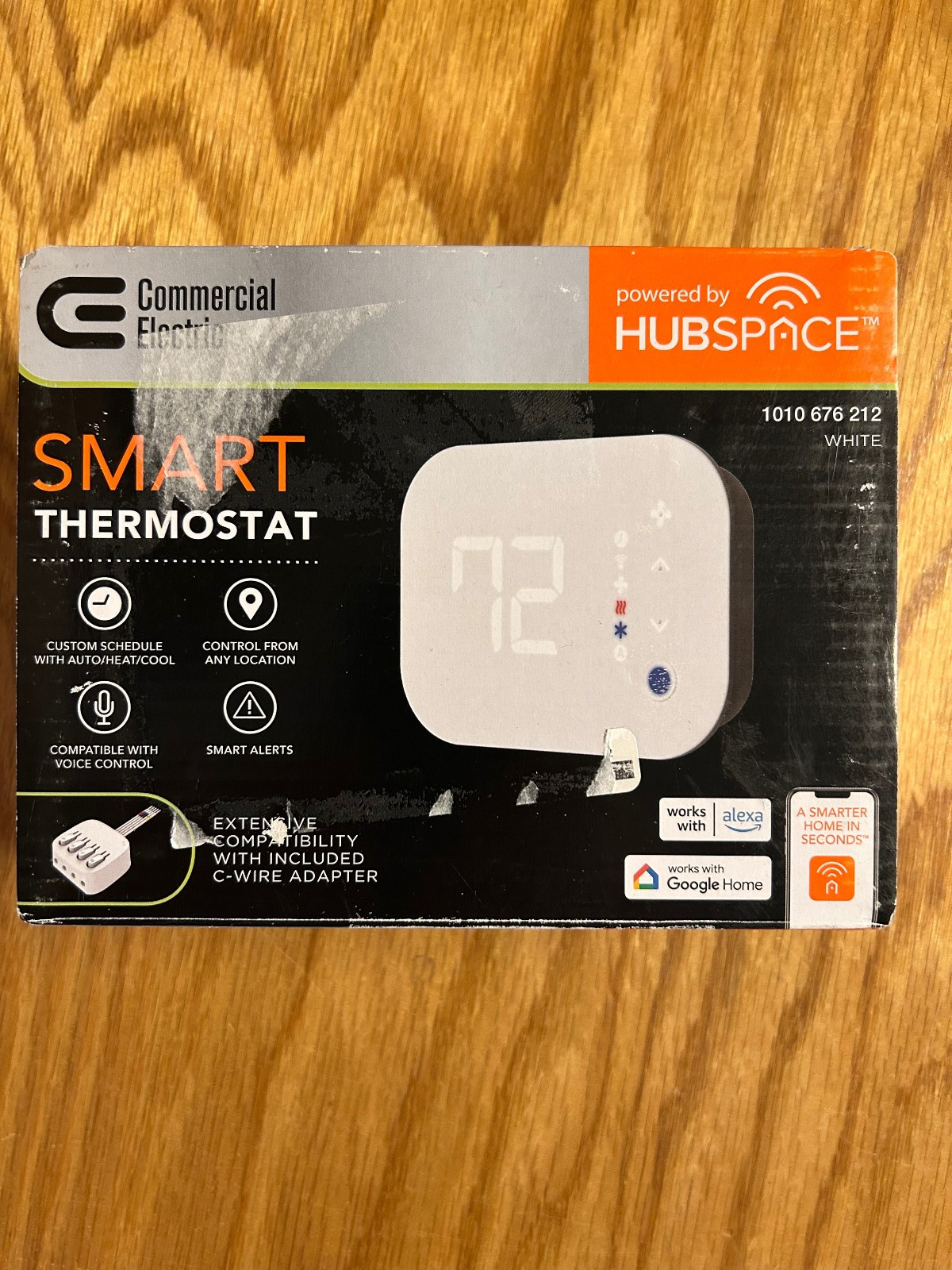
Hubspace, a newer entrant backed by The Home Depot, offers a simplified, cloud-based smart home experience. It focuses on ease of installation and use, primarily for devices sold under brands like Commercial Electric, Defiant, and Hampton Bay. While its ecosystem is not as expansive as the tech giants, its straightforward approach and affordability make it an attractive option for specific use cases.
- Strengths: Easy setup, intuitive app, cost-effective devices, growing range of compatible products, good for essential smart home functions.
- Weaknesses: Smaller ecosystem, less advanced automation capabilities, reliance on cloud for control, limited third-party device compatibility compared to major ecosystems.
- Protocols: Primarily Wi-Fi and Bluetooth.
- Compatibility Strategy: Hubspace prioritizes simplicity and a curated selection of devices. For example, the Commercial Electric Smart Thermostat powered by Hubspace highlights its focus on straightforward installation and management of home climate, home or away, via its dedicated app. This makes it a strong contender for those seeking an energy-conscious environment without extensive technical setup.
Protocol Deep Dive: Wi-Fi, Bluetooth, Zigbee, Z-Wave, Thread, Matter
Understanding the core communication protocols is essential for grasping the nuances of smart home compatibility. Each protocol has its strengths and ideal use cases:
- Wi-Fi: Ubiquitous in homes, high bandwidth, good for devices that stream data (cameras, smart TVs). Can suffer from network congestion with too many devices.
- Bluetooth: Low power, short range, often used for direct device-to-phone connections or initial setup. Bluetooth Mesh extends its range, but it's not a primary smart home protocol for large-scale systems.
- Zigbee: A mesh networking protocol known for reliability, low power consumption, and good range. Requires a hub. Popular for sensors, smart lighting (Philips Hue), and thermostats.
- Z-Wave: Another mesh networking protocol, similar to Zigbee but operates on a different radio frequency. Known for strong security and less interference. Also requires a hub. Popular for locks, switches, and security devices.
- Thread: An IP-based, low-power mesh networking protocol. Designed to be highly reliable and secure. Crucially, Thread is a foundational technology for Matter, allowing Matter devices to communicate efficiently without a central hub (though a Thread Border Router is needed to connect to the wider internet).
- Matter: Not a wireless protocol itself, but an application layer standard that sits atop Wi-Fi, Thread, and Ethernet. Its purpose is to unify how devices speak to each other, regardless of the underlying protocol, making cross-ecosystem compatibility seamless.
Smart Home Hubs: The Integration Backbone
While Matter aims to reduce the need for dedicated hubs, in 2026, hubs still play a vital role, especially for integrating legacy devices or protocols not natively supported by your primary ecosystem. A smart home hub acts as a central brain, allowing devices using different protocols to communicate with each other and with your chosen smart home platform.
- Centralized Control: A single point of control for all your devices.
- Protocol Translation: Bridges communication between Zigbee, Z-Wave, Wi-Fi, and Thread devices.
- Local Processing: Many hubs can run automations locally, meaning your smart home continues to function even if your internet connection goes down.
- Examples: Samsung SmartThings Hub, Amazon Echo (select models with Zigbee), Apple HomePod Mini (Thread Border Router), Google Nest Hub (Thread Border Router).
Choosing a system with a capable hub, or an ecosystem that integrates hub functionality into its primary devices, is a key consideration for optimal compatibility and reliability.
Comparing Smart Home Ecosystems and Device Compatibility
To provide a clear best smart home system compatibility comparison 2026, here's a table summarizing the key aspects of the leading ecosystems:
| Ecosystem | Supported Protocols (Native/Controller) | Key Strengths | Key Weaknesses |
|---|---|---|---|
| Apple Home | Matter, Thread, Wi-Fi, Bluetooth | Privacy, Security, Apple integration, reliable | Higher cost, more closed (less so with Matter) |
| Google Home | Matter, Thread, Wi-Fi, Bluetooth | AI/Assistant, broad device support, smart search | Privacy concerns for some, can feel less cohesive |
| Amazon Alexa | Matter, Thread, Wi-Fi, Bluetooth, Zigbee (select Echo) | Vast device ecosystem, affordability, routines | Can be overwhelming, privacy concerns |
| Samsung SmartThings | Matter, Thread, Wi-Fi, Bluetooth, Zigbee, Z-Wave | Multi-protocol support, advanced automation, DIY-friendly | Complexity for beginners, hub dependence |
| Hubspace | Wi-Fi, Bluetooth | Easy setup, cost-effective, curated devices | Smaller ecosystem, limited advanced features |
The User Experience of Compatibility: Apps and Automation
Beyond the technical specifications, the practical user experience of a smart home system heavily relies on the quality and reliability of its companion app. An app that struggles with device discovery, inconsistent reporting, or frequent crashes can severely undermine the perceived compatibility, even if the underlying protocols are sound.
User feedback on smart home manager applications often highlights this point. Some users, like those reviewing the "Smart Home Manager" app, express extreme satisfaction:
"Truly, the best App for any WiFi Connection out there." (Source: apple_reviews) and "1000/10" (Source: apple_reviews) are common sentiments when an app performs flawlessly.
However, reliability issues can quickly lead to frustration: "Works good for 24hrs then I have to restart Gateway and erase and redownload App. Works great then out of nowhere it will not tell me the devices on router. And what devices are using what. Very FRUSTRATING!!!! Fix this please" (Source: apple_reviews). These experiences underscore that true compatibility extends to the software interface that brings all the hardware together. A system with excellent protocol support can still disappoint if its control application is buggy.
Effective automation is another cornerstone of a compatible smart home. The ability to create complex routines, scenes, and conditional actions across different device types is where the power of integration truly shines. Whether it's turning on lights when a motion sensor is triggered or adjusting the thermostat based on presence detection, a robust automation engine is vital. All major ecosystems offer automation features, but their flexibility and ease of use vary significantly.
Advanced Considerations for Smart Home Compatibility in 2026
As smart homes become more sophisticated, several advanced factors influence compatibility and overall system performance:
Security and Privacy
The more devices you connect, the larger your digital footprint becomes. Strong security measures, including end-to-end encryption, regular firmware updates, and secure user authentication, are non-negotiable. Privacy policies, detailing how your data is collected, used, and stored, also differ greatly between ecosystems. Apple, for instance, emphasizes on-device processing to protect user data, while others may rely more heavily on cloud analytics.
Scalability
Consider your long-term smart home aspirations. Will your chosen system support dozens or even hundreds of devices? Can it handle multiple users and complex network topologies? For those with extensive needs, exploring options like the Best Home IoT Platforms for Large Households 2026 is essential. Scalability isn't just about the number of devices; it's about the system's ability to maintain performance, responsiveness, and manageability as it grows.
Reliability
A smart home system is only as good as its weakest link. Consistent performance, minimal downtime, and quick recovery from issues are paramount. Factors like network stability, device quality, and software updates all contribute to overall reliability. For a deeper look into enduring performance, refer to our analysis on the Most Reliable Smart Home Systems 2026: Expert Analysis.
AI and Voice Assistants
The intelligence of your voice assistant plays a significant role in how effortlessly you interact with your smart home. As AI capabilities advance, voice assistants are becoming more proactive, contextual, and capable of handling complex multi-step commands. Their ability to integrate with various smart home devices is a core aspect of compatibility. For insights into the future and current state of intelligent control, our Best Smart Home Assistants Compatibility 2027: Expert Guide offers a forward-looking perspective.
Real-Time Monitoring and Auditing
Beyond simple control, modern smart homes are increasingly capable of sophisticated monitoring. This extends to energy consumption, security alerts, and even the health of the devices themselves. This capability aligns with broader trends in infrastructure management:
"The modernization of power distribution networks into intelligent Smart Grids necessitates a paradigm shift from periodic, manual inspections to continuous, real-time feeder monitoring and auditing. Traditional systems, reliant on legacy SCADA and manual meter reading, are plagued by high Aggregate Technical and Commercial (AT&C) losses, prolonged outage durations, and a lack of granular visibility into feeder health." (Source: crossref)
While this quote refers to large-scale power grids, the principle applies to smart homes. Granular visibility into device status, energy usage, and network health allows for proactive management, optimizing performance and identifying compatibility issues before they become major problems. Smart home systems that provide robust dashboards and analytics offer a significant advantage in 2026.
Emerging Trends Affecting Compatibility Beyond 2026
The smart home arena is constantly evolving, with several trends poised to further shape compatibility in the years following 2026:
- Further Evolution of Matter: Expect Matter to continue maturing, adding support for new device types and refining its interoperability capabilities. As more manufacturers adopt Matter, the "plug and play" vision for smart homes will become an even closer reality.
- AI at the Edge: More smart home devices will incorporate AI processing directly on the device ("at the edge"), reducing reliance on cloud computing for faster responses, enhanced privacy, and improved offline functionality. This will impact how devices interact and what level of intelligence they can offer independently.
- Immersive Experiences and AR: While still nascent, the integration of augmented reality (AR) with smart home control holds significant promise. Imagine controlling your lights or thermostat with a gesture seen through AR glasses. As AR gaming glasses are evolving with specific feature demands to deliver high-quality immersive experiences, the crossover into smart home interaction could create entirely new paradigms for control and feedback, demanding even more robust and low-latency compatibility.
- Energy Management Integration: With increasing focus on sustainability, smart home systems will deepen their integration with energy grids, allowing homes to dynamically adjust consumption based on grid demand, energy prices, and renewable energy availability. This will require sophisticated compatibility with utility systems and smart appliances.
Conclusion
As of April 2026, navigating the complexities of smart home compatibility is simpler than ever before, thanks to advancements like Matter and Thread, yet choices remain important. The best smart home system compatibility comparison 2026 reveals that while all major ecosystems are embracing open standards, each still offers a distinct user experience, a specific set of strengths, and varying degrees of support for different protocols. Apple Home excels in privacy and integration for Apple users, Google Home leads with AI and broad device support, Amazon Alexa offers unparalleled choice and affordability, Samsung SmartThings provides deep control for enthusiasts, and Hubspace focuses on simplicity and ease of use for essential functions.
Ultimately, the "best" system is the one that aligns most closely with your personal priorities, existing tech ecosystem, and desired level of control. Consider your budget, the types of devices you plan to acquire, your comfort level with technical setup, and your long-term expansion plans. By carefully evaluating these factors and understanding the evolving landscape of smart home protocols and platforms, you can build a connected home that is not only smart but also seamlessly compatible and a joy to live with for years to come.